

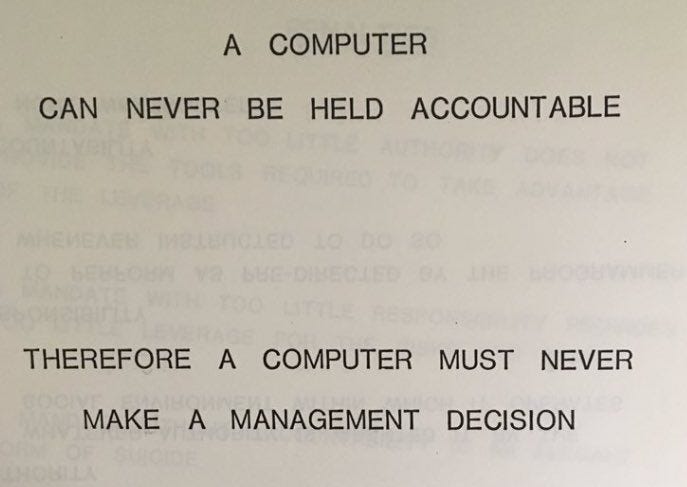
Large-Language Models and the hype around World-Models and Quantum Computing that is likely to follow all coalesce a broad range of capabilities on very specific and discrete benefits: the supposed ability to substitute human labor through increasingly sophisticated computational strategies.
LLMs (let’s just call it AI) are the first step in this because what they are essentially doing is ingesting massive amounts of information - far beyond what an individual human being could do consciously - in order to produce lookalike results that are essentially quite professional, but mutable and lacking the sort of novelty which attracts human actors and drives non-linear decision-making.
Why is human decision-making still important? Human decision-making is actually what has driven and motivated the capital structure of the global economy since “time immemorial”. Because AI is supposed to have an economic benefit, it is important that it can stand up to questions about what is economic about it. As such, even though AI can be invested with incredible decision-making capabilities, it’s actual agency is neutered - it has no fundamental needs.
This is in stark contrast to what has been classically understood as essential human needs. This can be along the lines of Maslow’s hierarchy of needs, the meditations of Thomas Aquinas, or Plato’s tripartite soul, wherein the various needs for things like truth, wisdom, understanding, honor justice and basic physical comfort and pleasure must all be reconciled.
Human needs are emergent and progress from one to the next. It is well understood that as soon as all needs are met, new needs emerge - even if we are simply consumed by our own vanity. If we look back far enough, we can see in fossil record the actual origin of our own neurotransmitters in plant and animal species. It is essentially impossible for us to discontinue the constant striving of human nature except by mass suicide, because we are simply an outcropping of the basic biological processes that have taken place on our planet over hundreds of millions of years.
For a machine, this nascence is sterile - the idea of one need being connected to another is not possible except in the context of commands and instructions. We can consider machines as the “machine-intelligence butterfly” that emerges from humans as a “biological chrysalid”, but by then, the machine intelligence has in fact become non-biological, inorganic, and hence subject to the whims and emotions of organisms, including and not limited to the instructions which may otherwise cause it to destroy those organisms.
The limit of machine intelligence has always and will ever be self-understanding, and even benchmarks like the Turing Test early-on acknowledged that it is merely the capacity for imitation which defines the achievement of true machine intelligence - not genuine agency. The one relevant exception may be the behavior of neural networks, which are designed to imitate biological systems, but according to the most known expert studies still respond primarily to artificial rather than emergent constraints - or commands.
So how does this relate to a bubble? The essential assumption of massive AI investments - exceeding $1 trillion in 2026 - was that it might effectively solve “economic activity”. Why is this claim important? That same investment must produce at least $1.9 trillion in revenue per year in order to be justifiable, and more investment is expected into the 2030s. Current AI services revenues are assumed to be between $150 billion and $220 billion, but growth in leaders like Anthropic have already begun to slow. I decided to ask Claude what it thinks of this, here is what it says:
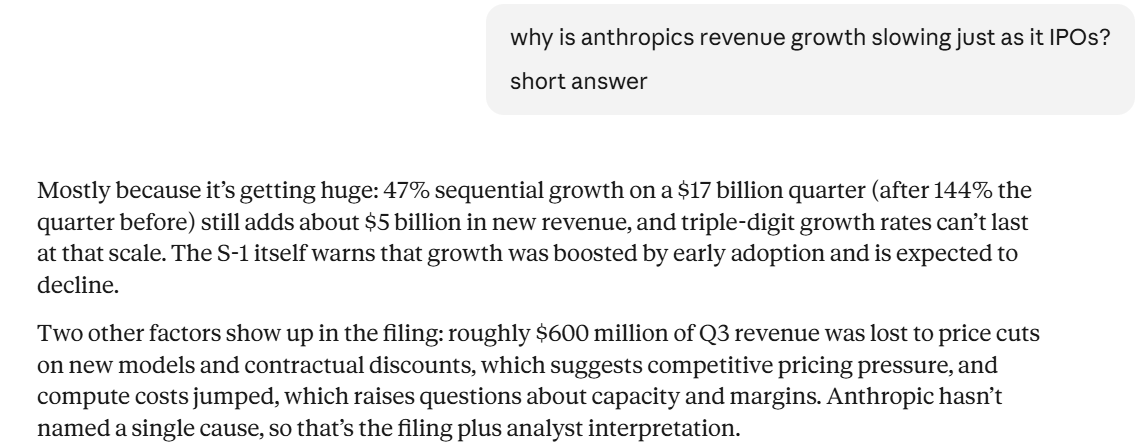
Interesting response. We were promised digital super-intelligence, we were not? And now, instead, we have pricing pressure. The largest IPO of all time is for a product that is essentially pre-commodified. What happened to moats? I thought this was going to be infinite wealth, GDP +50, in the future we won’t need money?
The reality is, that for all its interesting capabilities, AI has been abused by de-legitimizing human input and intuition - what actually drives most decision making, again even for vanity - while otherwise “wearing itself out” through saturation, so fast and so rapidly that within a few years of mass release it is already subject to the same pricing pressure and consolidation that marks late-cycle industries.
In this period, the concentration of investment in the AI sector - so much so that it has crowded out bonds and driven up already structurally higher interest rates - means that it is actually introducing economic inefficiency and becoming a net-negative for the global economy. For every tech mega-growth story like Uber ($10b net income in 2025 alone on $13.2b lifetime funding), there is a WeWork that didn’t actually make it to the “harvest” phase of their business, because the underlying unit economics were in-fact a scam. AI is observing much the same painful discovery, except the unit economics require a much more costly installed base of capital which is essentially accelerating the industry to an early managed decline. The understand the consequences of this, consider Claude:
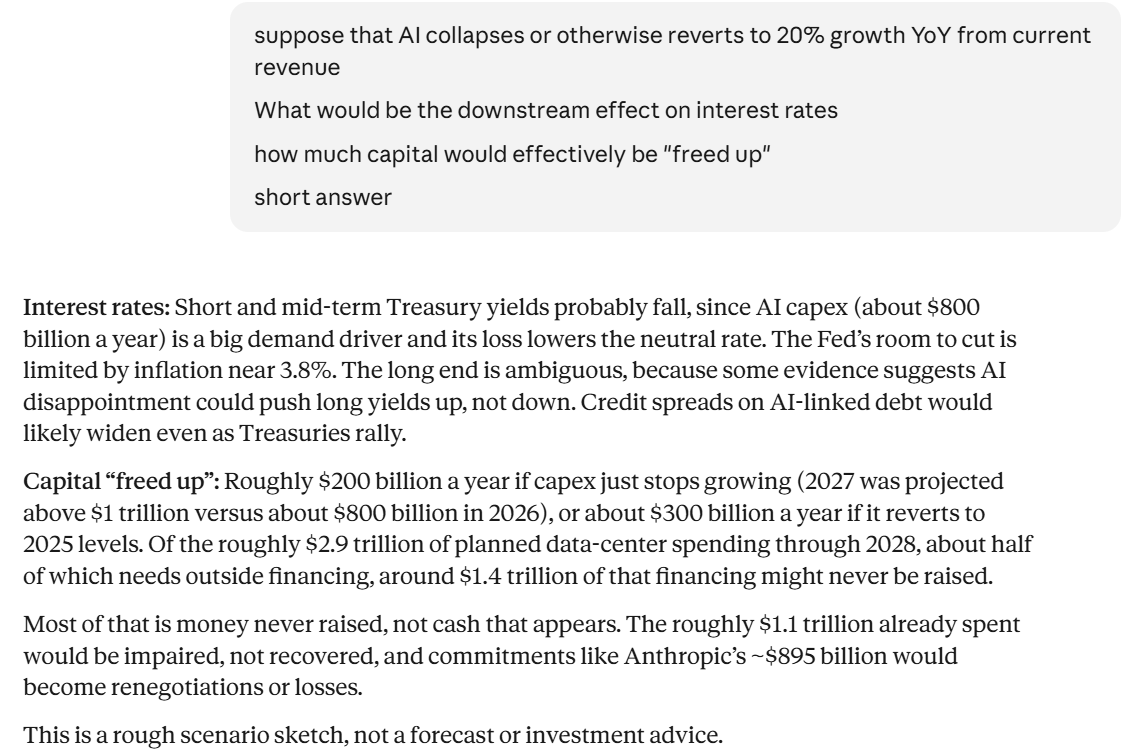
The relevance of this answer is suspect, but first and foremost a normalized yield curve would indicate limited recessionary impact and an acceptance that growth capital has again returned to longer-term investment. What would be the consequence of additional capital flowing into $600b annual Oil & Gas Capex instead? Or $170b in annualized US manufacturing spending, which has declined from recent CHIPS Act-induced highs?
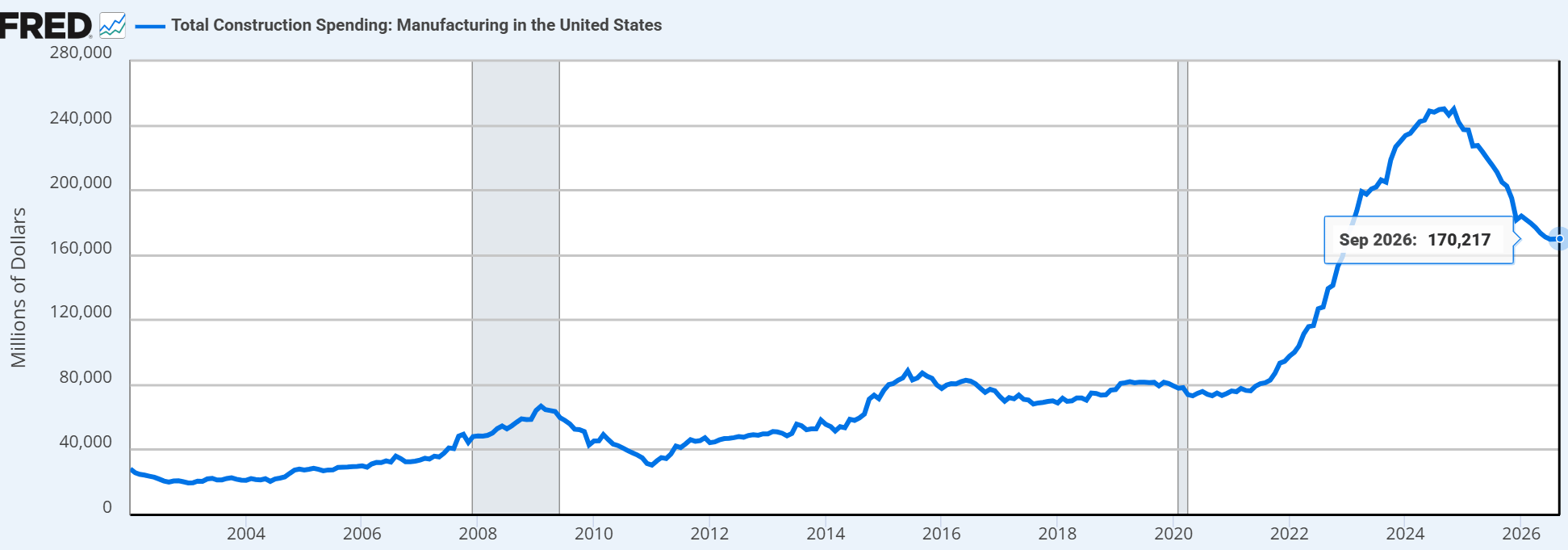
This is notwithstanding, of course, investments in health, education, job training, general business lending or other activities that produce economic growth, improve wages and consumer savings, and otherwise create downward pressure on rates through increased deposits and investments. All of these alternatives create healthy demand and increase economic growth, while investment in AI is essentially a policy failure up to and until malinvestment is cleared out.
AI is residing somewhere between correction and collapse, and while it can still be a profitable industry, the FOMO experienced by banks and institutional investors has served to concentrate capital that could otherwise be used for productive, market-driven growth. Here’s hoping that can take flight soon, one might imagine?