

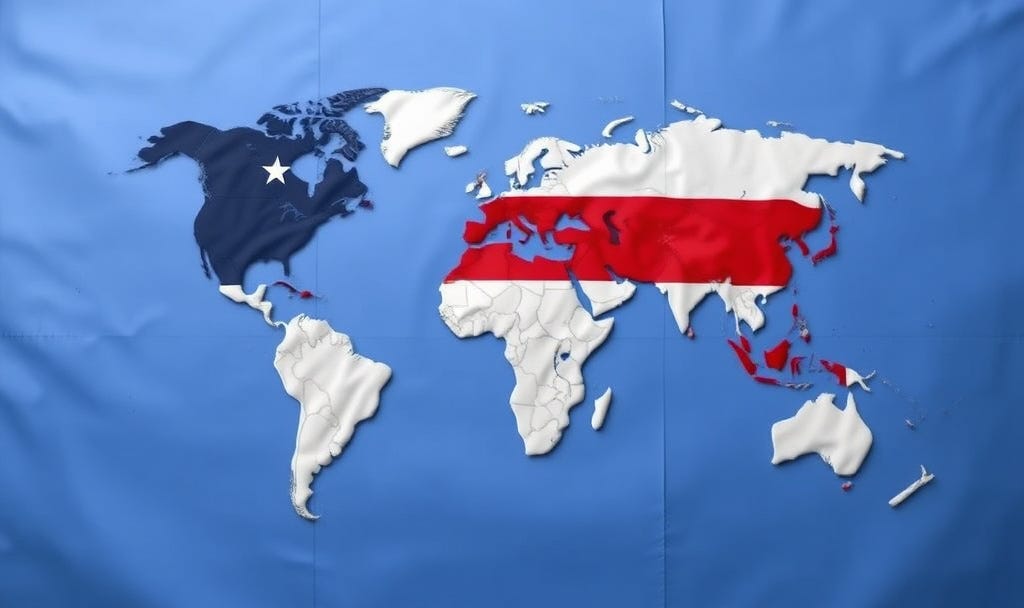
We are in the midst of an unprecedented marketing campaign, synchronized around a USA-hosted World Cup, a for-the-time-being peace in the Middle East and gas prices that are gradually returning to normal. While many European tourists remark at the lush affluence of American suburbs, the grandeur of Costco and the generous dispensation of indoor air conditioning, social media is being used to amplify these messages in concert with the usual Fourth of July rah-rah patriotism.
Some of this may be accurate to the global attitudes and perceptions towards the United States. While it is a global empire that works with its malevolent lacky Israel (just carrying forward the global characterization, here) to destabilize and undermine what would otherwise be peaceful and prosperous countries for its own benefit, it is also the center of global innovation, a power broker in every part of the world map, and (though only when politically convenient) does come to the defense of the poor and the downtrodden in many scenarios that otherwise are not considered the purview of a global hegemon.
The decline of international liberalism has increased a longing for it, but also shown how the “might makes right” return of history isn’t necessarily all its cracked up to be. The WEF contingent is pushing its “Middle Powers” approach but lacked any agency in the biggest international crisis since the launching of the Iraq War (the Iran War), while China and Russia are mostly mum on anything that is not directly on its borders.
Much of this may come down to the classic Mackinderan hypothesis - that sea powers must project outwards to grow while land powers are always preoccupied with internal stability - but in a consequentialist mood, we must ask ourselves, is there something about the sea powers that make them so powerful? Are there cultural attitudes or values which make them by their nature more able to project their culture outwards and encourage others to emulate them? In the past, the citizens of the USSR could never say no to a pair of blue jeans (so we’re told), but what other aspects of the “upstart” and “self-determined” culture that drives individuals to embrace the sea could be seen as advantageous, even for those accustomed to a land with lords and ladies, with boundaries that they cannot cross, and otherwise stable - though sometimes miserable - ways of life?
In the coming decades, a few forces will shape the global economy, barring any radical detour or interruption: global finance will become increasingly decentralized, manufacturing will become increasingly automated, the traffic of physical goods will be increasingly moved to space, and the attitudes towards land, hearth, home, growth and reproduction will become increasingly selective. The “return on capital” of an individual human being will not be as impactful as what is invested in that human being - whether it be acculturation, education, primary care, or even genetic engineering - and those human beings may go further with increasingly selective and hedonistic attitudes towards the actual reproduction they experience.
This is, of course, not a transition that will happen all at once, but in some series of stages that will appear both remarkable and banal depending on one’s time a place. It is perhaps a diffusion of prosperity, but also a release on the unrelenting ability of markets to deliver more goods (useful and not) at cheaper prices and while consuming fewer resources.
This does not mean that life will necessarily be better for most than other times in history, like the Post-WWII economic prosperity we will likely fantasize about for generations to come. If you had told most people that the “Gunsmoke” era was in fact a Golden Age, they may have laughed in your face, or spit out their ice cream, but this is again the combination of the remarkable and the banal - stable societies are far less interesting from the inside than the “outside looking in”, as it were.
Today’s America is far less stable than it was, but far less precarious than other nations in a world of globalization. There are no meaningful threats on its borders, it continues to attract foreign talent, it’s GDP growth remains vertiginous and it actually has one of the highest fertility rates in the developed world. The only thing stopping American culture from substituting global culture is in fact its American-ness - “Heritage” Americans in many ways view the United States as being defined on some level by its own nativism, isolationism, “city on a hill” characteristics.
Though these are often prejudiced opinions, the prejudice is not always the point - the idea of what is good about the United States being its exclusivity, despite the fact that it historically has arguably the most open borders of any country ever, ultimately allows people to think that exclusivity will by its nature make whatever is worth preserving ultimately become preservable, without even necessarily knowing what is actually to be preserved in the first place. Maybe that’s what happened in Rome too - “yeah, so what, citizenship is expanding pal, have you gotten a load of these loaves and circuses yet?”.
So, in many ways, American culture - particularly in its nationalist characteristics - is a sort of “Schrodinger’s Box” of attitudes. It is at once hierarchical and rewards only those who “work hard”, but a land where “anyone” can ultimately succeed. It is made up of reserved, Protestant, forthright people who resist collectivism but never hesitate to lend a hand, and yet of its most represented religion, Catholicism is now its most recognized denomination. While this for some may have appeal in a sultry love-of-life, is it not also what founders of English and Anglican stock viewed in some sense as a great nightmare?
America and Americanism are a kaleidoscope, a chameleon culture, and one that necessitates no culture at all as a starting point. This was in fact early Protestantism in many ways: bare churches were a blank slate for the soul, and it was in fact only the meritocracy of hard work which would give you even an off-chance of consorting with the divine in the beautiful hereafter.
So, in a sense, whether liberal, conservative, or some other arrangement, America 250 is in fact an America “not with me” - individualism is the only substrate on which the culture persists, even in its so called “Rise of Socialism”, and at its base, can a total reduction to individualism ever celebrate the state?
As the world becomes more American, perhaps in the way that Europe became Roman millennia ago, is it ultimately suspicion of the state which will be the most lasting characteristic? And, thus, in the end of nationalism, will the most free-associating nationalistic state on Earth ultimate lead to the total erosion of its most defining, patriotic ideology?
Much to consider, as it were.