


The “World Systems Theory” of Immanuel Wallerstein, with a complement of Oswald Spengler’s “Cycle Theory” of Civilization, are incredibly useful tools for thinking about where the world is now and what happens next.
World Systems Theory argues that global economies are constituted of “Core” and “Periphery” countries which interact based on variations in their capital intensity and tendency to add-value (e.g., “a lot or a little”) to the products they produce and services they provide.
Spengler’s Cycle Theory complements this well, as it hypothesizes four “seasons” of civilization - Spring, Summer, Autumn and Winter. In each, different characteristics predominate: Spring and Summer are characterized by the culmination of unsophisticated, mythologically-driven agrarian societies that slowly build complexity and a sense of common identity.
Towards the end of “Summer”, this identity achieves more definitive expression, where Autumn is then defined by the repetition of these identities in the context of city-dominated intellectual elites, where complexity and specialization within an economic or political system is highest, but the source of wealth in the rural hinterlands is slowly hollowed out of population. Finally, when this regime can no longer sustain itself, urban centers break down towards more outright populism, authoritarianism, government largesse, ballooning bureaucracy and “bread and circuses” to calm and soothe the people in their world-ending anxiety (stop us if this sounds familiar).
When we take the systems together, we can assume that Western Europe was in its “Summer” in the 18th and 19th century, while the United States took up the mantle in the late 19th and into the resolution of World War II. In the time since, Asia developed more aggressively, but seems to have adopted much the same malaise as the West, with societies which have become nearly as “geriatric” despite their outstanding economic growth.
Spengler argued that civilizations in Winter cannot be salvaged - indeed it is only their eventual destruction that allows for rebirth. We can imagine this as having taken place in the “Western System” between the fall of Rome and the rise of Enlightenment society - after the Third Century, Roman identity had become so diluted that the broader set of European elites saw no reason to fight for the central institutions that remained. Hence as those institutions died off and poverty ensued, the eventual rise of Charlemagne and other kings from the 8th century onward enabled a reconstitution of centralizing institutions within the European Continent.
This new order substituted what was once a Caesar and the various Equestrian classes of Rome, as well as the distinction between slaves and free Roman citizens, with Kings, Lords, Priests and Serfs. As time went on and the economy of Europe reconstituted itself without broad reliance on the Mediterranean, Free Cities emerged along the major trade route between Lordly centers which hence allowed “Free Citizens” to become artisans, bankers, and otherwise specialize in trades, gradually increasing the value of goods generated by the European economy.
The Renaissance - driven by urban lay elites - along with the Enlightenment and the redefinition of rights and privileges that followed - States, Elected Representantives, Magistrates and Citizens - formalizing new attitudes of reciprocity, equality under the law, and the free participation of individuals in civic discourse that had been emerging since the era of Charlemagne (and were more strictly formalized in contracts like the Magna Carta, as we are always reminded).
This is broad scope, certainly, too broad - and you may be asking, what does this have to do with Welfare States? In essence, it has only everything to do with them: welfare states are the culmination of the progressive or “Whig” view of history, where everyone can exist in a sort of Garden of Earthly Delights, wanting for nothing and free to pursue intellectual and moral perfection while contributing to the underlying economic growth of society only once they are perfected moral citizens. Taken more cynically, however, welfare states are simply modern benefit regimes - the “bread” component of “bread and circuses” - and they perform a vital role of stabilizing social discontent and minimizing disorder as central institutions continue to expand to a point where they can no longer be justified… where our inevitable “Winter” is complete.
The unfortunate component of the progressive view of history is that it is essentially a game of musical chairs. One disenfranchised group after another finds its “seat at the table”, until we are meant to invent new disenfranchised groups out of whole cloth - surely the result of deep moral investigation - and while these groups can for a time begin to rest their delicate buns, the reality seems to be that the music does in fact stop - particularly when society is too distracted to notice its “endogenous” harbingers of decline.
This is essentially what we observe now: governments bloated beyond sustainability or justification, the actual bankrupting of welfare schemes, long-term demographic decline that at first was substituted with aggressive immigration policies which now too cannot be sustained - either politically or even on the fiscal cost of integrating new entrants to society. While Western Democracies - and yes, also China - are now so capital intensive that they can still produce apparent growth, they are increasingly feasting on the seed-corn of their own societies in order to produce them. Young people require years of education, work and training to even develop the scintilla of stability required for them to have kids, and many put it off so long that they effectively squander the most fruitful of their child-bearing years - see now how more turn to freezing eggs and sperm.
Importing labor worked for a time - local elites from far-off countries were happy to send their young to learn, work, grow and plant down roots in the West - but now the trend in immigration has implied that many local elites are satisfied where they are, and while less-privileged classes now have the mobility to come to the West, they are not strictly prepared to substitute the higher-value-added labor that permits a generous welfare state to go on indefinitely.
So where is the center moving? In the sense of Wallerstein’s Systems Theory, he would perceive it as moving East, but those countries are additionally in demographic and “cultural” decline, growing increasingly unable to sustain themselves in much the same way the West is. One could accuse Russia of resolving this with a new phase of imperial expansion, but even the most generous of evidence shows that their core demographic decline has only accelerated since the beginning of the War in Ukraine.
Birth Rates in Central Asia and parts of the Middle East remain high, while North Africa and South America are effectively mired in relatively generous welfare states, high debt with low overall fertility - triplicate burdens which are essentially impossible to reconcile. Even India is now below replacement fertility, while Sub-Saharan Africa remains above replacement and - though trends follow the developed world down - lacks the level of capital and development to swiftly become the “high value-added” center of the Earth.
While this could be a long-term possibility, in that time frame we are all dead (to nod to Keynes), which implies that the Whig dream of broadly distributed growth - of successful middle classes and high social mobility - is for the coming decades simply a pipe dream, at least until we digest our current demographic deficits. “Optimists” in the West are hoping AI can unleash a new era of productivity - productivity versus investment which has yet to be realized and is now being called into question.
Should that age of AI arrive, it will generate huge profits, but without either massive upward pressure on capital expenditure via accelerating labor productivity, OR direct redistribution of this new wealth, there is no possibility for reversing the decline of the current World System. At that, redistribution would need to target those of child-bearing age - not the retired and the infirm, but those able to generate offspring that actually “operate the machine” - there is basically no foreseeable positive outcome, only a reproduction (pardon the pun) of the same fiscal and demographic deficits which persist today.
At this stage, again, we must take the contrarian view - if only for rigor: Is it possible to say that developed economies have become too productive, and that in order to reduce the likelihood of demographic (and subsequent economic) decline, careers must essentially be put off, limited or otherwise adjusted such that we should reduce workforce participation during peak years of fertility, and otherwise increase it beyond the age of 65 (where retirement has been generally identified)?
We can emphasize, for instance, lifespan as generally 0 to 80 or 90 years old (god willing), “Healthspan” as 0-35, and “Workspan” as 35-75. The total benefits of the welfare state, in many cases as much as 30% of the economy (as appears to be the case in France) should be dismantled or otherwise targeted towards the young (excluding hardship scenarios), and in this time, young people are encouraged to develop both their maximum value as individual contributors to capital and make “deposits” (not a pun) on future returns to capital by expanding the labor force (i.e. having kids). The only question is how specific benefits should be. Should there be baby bonuses? Benefits per child reported at home? And how can we determine that those children are actually being raised to become net creditors to society down the road?
The short answer is that there is no real way to know. No nation in history has attempted such a massive transition in social policy, brought on by modern productivity gains which have essentially led to a relative devaluation of employees who are in their prime child-bearing years. We may assume that overall life satisfaction generally contributes to the perpetuation of high-trust, high productivity societies (excluding instances of sociopathy and psychopathy, perhaps). To support the continued realization of high quality and quantity of life, we may imagine the relevance of studies showing, for instance, that children can offer the broadest improvement to life satisfaction, but only to affluent parents who have their first children after 30. Surveys can be useful, but it is important to understand what mediates the most meaningful drivers of happiness and life satisfaction.
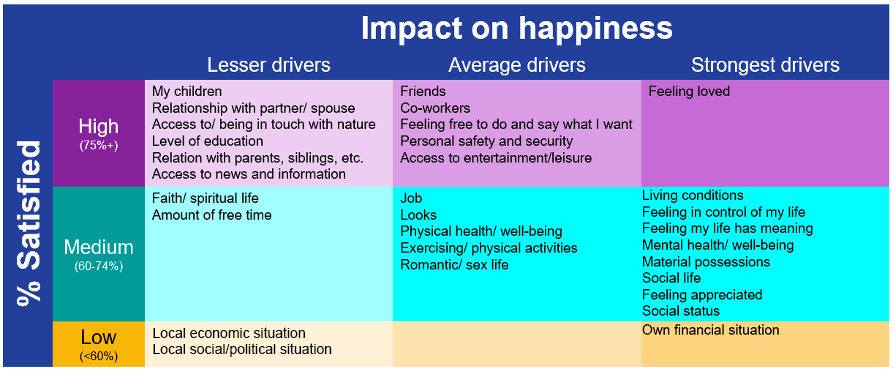
For most people, social relationships are what drive the highest degree of happiness and life satisfaction - whether that means strong integration at work, school or within a family. The largest component of our lifespan is increasingly, however, our old age - a portion of life that is increasing with advances in medical technology, and a time where we are otherwise most disposed to spending time with people younger than us - our own children or otherwise - because those within our peer groups begin to die off.
Hence, relationship-driven life satisfaction is dependent on people existing in the first place, and in sufficient numbers and productivity to create that “crowd” or “tribe which makes us feel at home. Life satisfaction is critical to the underlying vitality of an economic system, far from being an ends of “general happiness” along the lines of utilitarians like Jeremy Bentham or John Stuart Mill. And an increasing number of studies show that life satisfaction and happiness do in fact increase with children, where other variables like income, status and the ability to maintain habits of personal care are held equal.
This in fact reveals the tradeoff that many are managing before they decide to reproduce: they want to maintain or exceed a standard of living to which they are accustomed, which for them requires many years of study and earning to achieve, and by that time they are limited in the number of children they can simply create. Additional studies can confirm this. While demographic decline in the United States is a multifaceted problem, it is driven primarily by women delaying childbearing as they pursue education and begin their careers. The stigmatization of teen pregnancy, while traditionally correlated with highly negative outcomes, can be considered an extension of this phenomenon - someone who might have had children in their teen years, for whatever reason, will now have them otherwise later than they initially would.
From a behavioralist perspective, in order to maintain an acute level of productivity in current generations, we are actually chronically undermining the productivity of future generations, attempting to pull the productivity of the future into today (this is essentially how most social security regimes have been designed). In developed economies, the primary challenge is maintaining population growth sufficient to realize the cost-effectiveness of large industrial systems, which are in fact how capital is domiciled in the global economy. Specialization, through the division of labor, is primarily what drives economic growth. In order to support extensive specialization and complexity, populations - for the most part - must be large and growing. What’s more, sufficient labor pools are necessary to justify fixed capital investments. China realized the benefit of this “arbitrage” following the end of the Cold War by attracting capital to its massive and increasingly educated and skilled population. Now, a global convergence of wages means that industrial firms are actually leaving China for still-developing markets with rosier demographics and, as such, cheaper net labor costs.
Investments in automation are considered an alternative to this approach, but they also require stable demand in order to justify long-term investment, which is also essentially in structural decline as rich countries depopulate. We are not necessarily worse off as population plateaus while wealth remains somewhat constant, but we see the secondary effects of lower-growth, lower-reproducing economies in the rise of addictions - whether to drugs or screens (whether social media, video games or pornography) - as well as globally lower reports of life satisfaction, particularly among youth, who see life as too complex, or simply too formidable and demanding to participate in relative to the vices they can otherwise indulge in at a moment’s notice.
Certainly young people can always be more accountable to their own outcomes, but it also appears that this delaying effect can have a major contribution to driving down overall life satisfaction. Increases in average years of schooling have been a way for developed nations to remain globally competitive (useful graphic here), but in countries like Germany (14.3 years on average) and Canada (13.9 years on average), individuals essentially spend their prime child-bearing years “still in formation”, with the additional cost of housing and consumer goods remaining sufficiently high for them to put off reproduction into their prime professional years when they are simply otherwise less fertile. In addition, once they have realized high incomes, a new tradeoff emerges - having kids and caring for young children in particular - even if only in the mornings and evenings, means they have to spend even less time earning.
Those obtaining professional or graduate degrees may spend as much as 20 years or more in total in schooling, with an additional 5 or 10 years to “work in” to their career (at a constant rate), that can leave only a few years in the late 30s where children becoming a clear possibility - a time when fertility and certain aspects of physical health are already in decline, relative to its peak in the early and mid 20s. The aforementioned freezing of eggs and sperm are more popular as a consequence, but can be costly, have no guarantee of success, and in some cases reduce outcomes regarding childhood health and wellbeing. As far as immigration substitution is concerned, it is also quite common for second and third-generation immigrants to realize the same tradeoffs historical populations have in the West, and subsequently adopt the same habits of reproduction that reduce overall fertility as well.
And while we must ask if the “West” - or the current global system - is worth saving, the most obvious answer should be “of course”. No global regime has lifted more people out of poverty, driven more diversity in the expansion of mass culture, or produced more scientific and economic output - this is not a function of the passage of time, but above-average returns driven by a combination of rapid generation and diffusion of innovation which has compounded on itself since the 18th century.
If that answer is acceptable (climate catastrophizers may disagree), a subsequent question follows: can it be saved? Spengler would say no, but it is only an investment in the vitalism of the young which can otherwise rejuvenate a stale and dying system, and based on the current fiscal position of most developed countries, it will have to come at the cost of the old and middle-aged. The solution should be obvious, but the reality is more political.
Current social welfare regimes have put developed countries, and even some less-developed counterparts, in debt and demographic spirals, and it is only investment in the health, productivity and reproduction of the young which will help solve that problem. Every dollar spent towards that end can pay dividends down the line, and every dollar spent elsewhere actually seems to consume those dividends, without much benefit to follow. While current social welfare regimes started with practical and even noble intentions, they have increased the size of government beyond what is sustainable, while lowering the productivity of otherwise well-functioning markets. They should be heartily reconsidered, if only for that reason alone.