


In “Economic Prospects for Our Grandchildren”, Keynes predicted that living standards would rise between 4 and 8 times between 1930 and 2030. In addition, he expected by the terminal date, a 15 hour work-week could become the norm. As a cultural consequence, people would devote more of their time to arts, leisure, literature and raising their children.
What was missing in that rubric - at least most obviously - is 1) cultural changes which disfavor having children (or having many children), primarily because the perceived status of those children is based on significant investment in their education and training for the job market, 2) the nature of the leisure, which involves mostly today a post-literate society inundated with short-form video and excess screen time in place of what were traditionally third spaces (church, social clubs, reading groups or bowling teams), and 3) that drastic increases in government as a portion of GDP (from around 15% in many places in Keynes time to more than 50% in many developed countries today) would reduce overall productivity in such a manner that, while incomes remain higher, costs of most goods and services balloon and hence repress the tendency of workers to reproduce, pursue meaningful leisure, and ultimately avert the reduction in work hours that Keynes envisioned (because they want to remain employed, since employment is seen as still scarce).
According to current economic statistics (usually among the most bald-faced lies known to humankind), GDP per capita globally has grown at a near constant rate since consolidated statistics were first generated in 1960. According to the chart below from FRED, it was $3,600 per individual in 1960 (in 2010 USD) and had risen to $12,310 per individual as of 2025.
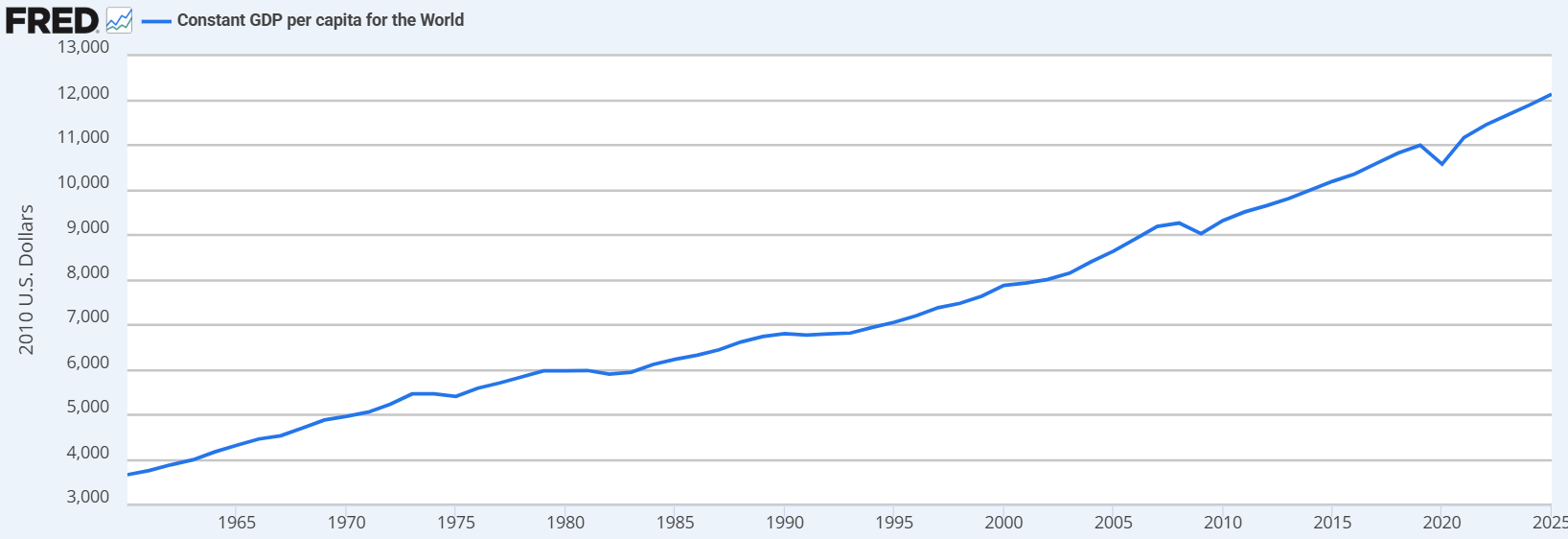
In the context of official statistics, this is a hair under the 4x that Keynes proposed over a 100-year timespan with 35 years remaining (30 to get to 1960, and an additional 5 to get from 2025 to 2030). Additionally, it equates to just under 2% annual real growth in global GDP per capita.
There is another measure of whether the constant 2010 USD is actually a good representation of the standard of living and dollar value that exists today compared to the past. Certain goods in the United States were more plentiful in the past - people seemed to eat more meat and dairy - while housing was generally more durable as it was built and consumer appliances lasted longer after their purchase date. Hedonic adjustments were introduced to CPI in 1998 (with a long history of number-fudging both before and after), hence while the nominal GDP per capita globally in 1960 was $452 and $761 in 1969, a Shadow Stats calculation (favorite alternative to the CPI, though it gets a little outlandish at times) would show that 1969 figure as being worth over $46,000 in 2022.
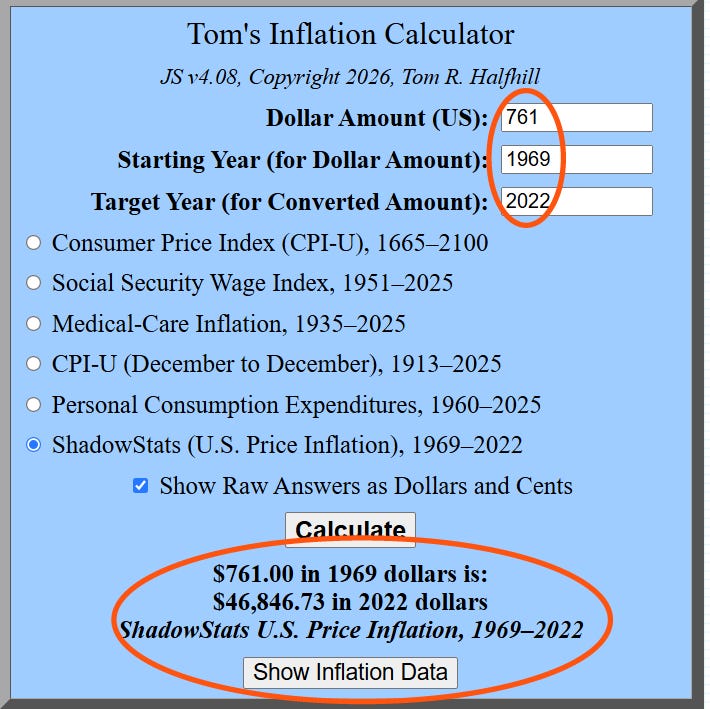
For those that want to play: https://www.halfhill.com/inflation_js.html
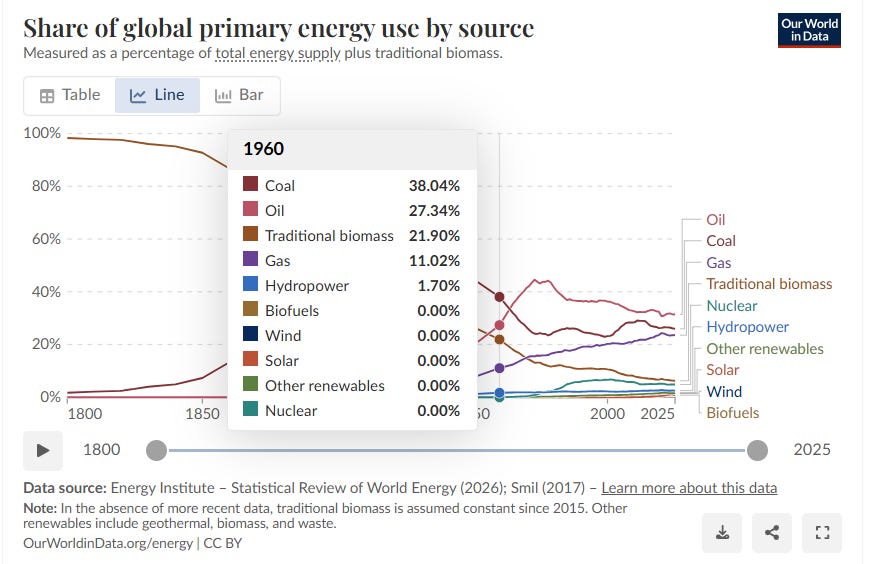
Nobody would believe this applies truthfully to global GDP and inflation today of course - much of the world’s population still lived in makeshift shelters and burned biomass for heat in 1969, and while many people still do today, the global population has greatly expanded around that relative “poverty” of experience - with the share of global energy usage as biomass consumption dropping from near 22% in 1960 to just over 6% today.
So, what is one to make of this outstanding progress, contrasted by a feeling of lack in Western economies? The first explanation would be that things were so good for so long in the post-war period, individual priorities became misaligned. In affluent societies, loyalties often devolve: instead of being focused on the strength of community and interpersonal bonds, individuals become more preoccupied with their cars, their houses, their status, keeping up with the Jones’s, or what they don’t have while others do. Screentime hasn’t helped this either - anyone who chooses to participate can find themselves bombarded with images of wealth, opulence and prosperity from the “haves” (or those claiming to be) and begin to feel inadequate, resentful, less-than or have-not as a result.
Gate-kept media imagery of the past was often a useful way for “power structures” (not conspiratorial, just coincidental) to induce some feeling of relative comfort. In the Soviet Union, lines for basic commodities (like toilet paper) showed that people were more able to spend time to line up for consumer goods than they were able to spend working. This is as much a scarcity of goods as a surplus of time, but in the West this was perceived as out-and-out scarcity. In the United States, grocery stores are full of goods and often empty of people except for peak shopping hours (much to the chagrin of Boris Yeltsin). This is a consequence of a surplus of productive capital relative to a scarcity of labor of those sufficiently capable to use it. In France today, people riot, as has often been the case since the 13th century, mostly because they have more time than money or goods, and they also use a lot of TikTok and Instagram, which can further increase the self-perceived have-not propensity.
As people have fewer children and global population plateaus, GDP per capita will likely only increase, but people will seem to feel less wealthy. Why is that? Financialization and debt? The overhang of too many years of schooling and education in lieu of being able to start a family? The lack of healthcare, housing and old-age care that makes even young people feel that they are competing against a ticking clock, indulging themselves in endless self-care and $20 avocado toast (perhaps we can say $25 avocado toast by now)?
The real reason, in the Austrian perspective at least, is that all these various regimes - high tax and benefits with reduced employment hours, or vice-versa and other variations - are essentially variations in the “Factors of production” which govern society. In order to have a clear division of labor, wages must be higher in some areas rather than others in order to attract skilled workers to those roles. If taxes are too high, that functions as a mild discouragement to those roles, but additionally, if services found in the market (particularly healthcare and education) are substituted by the government, the combination of bureaucratic path dependency - the everlonging need to expand - as well as the tendency of bureaucrats to shirk or overspecialize where they can, along with the economic limiters that come with invasive regulation, all combine to reduce the overall productivity and effectiveness of public services when compared to the private sectors.
In this case, many public services could be substituted with vouchers and quasi-public schemes or mandates - this is the case in the Dutch healthcare system, one of the most efficient in the world - and can be attested to with the rise of charter schools in the United States. Perhaps it is not reliable for individual consumers to understand what constitutes good healthcare or education, but the reduction of overhead will at least increase the efficiency of those services where good services are available.
Taking the example of France for instance - a country replete with social services and socialized costs, with a GDP per capita of $52,000 USD and government spending at 53 or 54% of GDP - what is to stop it from reducing overall spending by 5 or 10%, maintain 15 or 18% for provision of basic services and the military, and devote as much as 34% of GDP that remains to social transfers, vouchers, and redistributive spending instead of bureaucratic delivery of services? This amounts to nearly $18,000 USD per individual - including children and the elderly - while the average pension in France is approximately $1540 Euros per month - while a single direct universal GDP benefit would approximate $1300 USD per month.
It is not the fact of welfare states, but the fact of their inefficiency and their substitution of otherwise efficient markets, which is holding back productivity, increasing costs and artificially maintaining otherwise high working hours in the West, and additionally creating secondary costs when it comes to childcare, housing, education and reduced propensity to reproduce. People who work less can live farther away from work, devote more time to unpaid labor, and spend less on things they otherwise can do for themselves because they have the time to do them. Bureaucrats, on the other hand, create unnecessary labor - which they often fail to perform - because they must continue to justify their own position.
The substitution of current government services with direct payments would be both an equitable way to unwind overgrown welfare states and the bureaucracies that administer them, while also simplifying benefits, broadly balancing incomes, and increasing both growth and tax receipts - primarily through a mix of higher consumption for the most desirable services along with higher income tax receipts and sales taxes where applicable.
Government cannot fund itself today because it cannot create its own outlay to tax - this occurs only in the market economy, this was even the case in the Soviet Union, where increased taxes on alcohol ultimately drove the industry underground and bankrupted the state as a result. Voters need to be made to understand that fiscal balancing is not a matter of ideology, but simply a fact of life, and it can be done while maintaining existing benefits for seniors and without building another generation of civil servants trying to do from “first principles” what the private markets can ultimately do better - it is ultimately migrants, young workers, students, pensioners (where benefits are low) and the poor who pay most for policies like this, and resolving such discrepancies further serve as the best step to integrating them into society and economic activity in general.