


It has been understood for at least a few decades that some modest level of inflation is necessary to produce broad economic growth, because the velocity of money would otherwise decline if it only ever increased in value.
Through money creation at central banks and credit creation at private institutions, economies like those in China and Japan have gone from backward or dilapidated states into world powers with standards of living that are enviable to many.
While these strategies have also relied on currency devaluation to drive export-driven growth, their progress ultimately stagnates due to increasing cost of 1) inputs, 2) labor or 3) protectionism by their primary trading partners, usually to correct glaring trade imbalances.
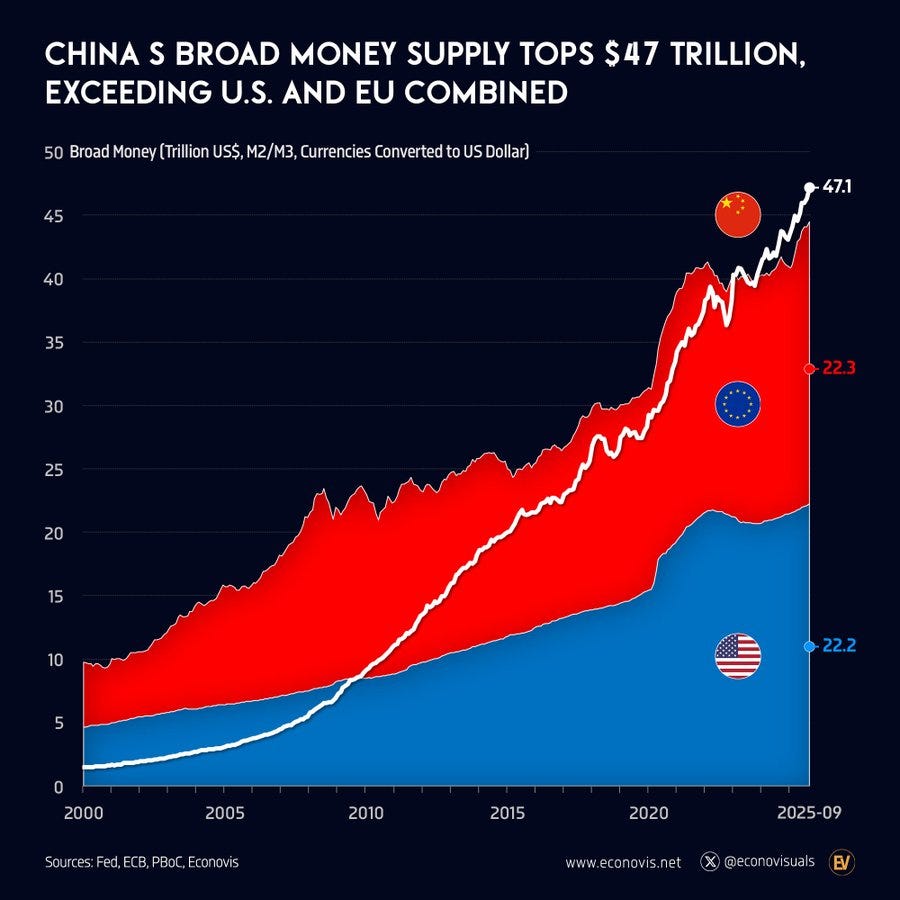
In this context, however, the rate of money creation for more valuable currencies - and hence the currencies of trading partners with which export-driven economies hold a surplus - can ultimately diminish the availability or propensity of consumers in those economies to actually buy more goods from those export-driven economies. The primary point here in contemporary times is the comparison between China’s overall increase in money supply - which outstrips the United States - while it’s total share of the global economy has actually declined.
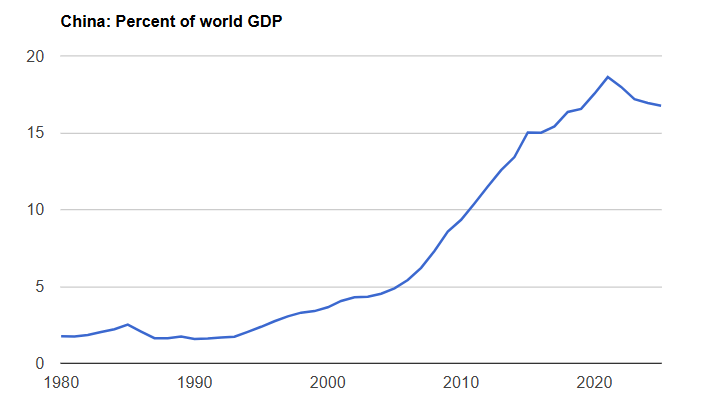
source: https://www.theglobaleconomy.com/china/gdp_share/
The United States is living out a law-of-large-numbers version of the Triffin Dilemma in which it now must continue to monetize debt at an ever higher rate just to keep the global economy moving. Without increased inflationary policy - even if inflation is perceived as high - there simply isn’t enough make-work to justify existing paper valuations, supposed levels of wealth, or (indefinitely) consumer appetites.
Some observers have begun to use the term “Fedsury” to hybridize the twin missions of the Federal Reserve and the Treasury in steering the US (and effectively the global) economy. The Powell era saw a mistaken return to perceived sobriety which, while calming the exuberance which marked the post-financial-crisis era, ultimately misdiagnosed the fact that the US economy, the US standard of living and US corporate profits all depend on a continually expanding global economy which - without judicious taxes and redistributive policy - creates both domestic inequality and resentment towards debt.
Ultimately, Congress is unwilling or unable to abide judicious policy, even if the populace would generally adore it (look for instance at the sacrosanct nature of entitlements. Simultaneously, overnight markets cannot even support the Fed’s current minimalist attitude towards its balance sheet - even the Fed subtly acknowledges this - while Bessent’s twist operation is only meant to serve as a prelude to future debt monetization that is a foregone conclusion.
As a result, the Fed will need to pursue debt monetization simply to keep the global economy afloat and avoid recession in the United States, but the two instances in which the Fed has pursued this policy previously were both responses to specific crises - World War 2 and the “re-housing” of subprime mortgage loans. In the current frame, the Fed and other actors must accept that - similar to the concept of “sustainable” government fiscal deficits to helps increase long-term economic growth - the Fed must also enable “sustainable” debt monetization to maintain both liquidity in the financial markets and further growth in the developing world vis-a-vis the US as the center of the global financial system.
The current playbook being run by the “Fedsury” is only meant to make the Fed appear as the “monetizer of last resort”. In different contexts, both Warsh and Bessent may claim to be good Austrians - economically speaking, and at least in spirit - but to the extent that an industrial base is essential for a modern nation-state to survive and enforce the very contracts Austrians hold so dear - they must in fact begin to monetize the very thing which both parties have avoided since the 1980s: the industrial redevelopment of the United States.
This would not be, in a sense, for the consumer goods which Americans consume from overseas, but instead the primary materials and machine tools which could then - by benefit of the consumption such economic activity encourages - maintain the import of light-industrial goods from overseas while heavy industry maintains a center of mass in the United States. The implications of this may or may not be interesting, but could be explored at another time.