


In The Great Transformation, a 1944 book by Hungarian economist Karl Polanyi, he argues that changes in late medieval England - primarily but not limited to enclosure acts - created a dynamic process which led to the emergence of a “Market Society” that replaced previously reciprocal social tendencies with official institutions which would from thereon stabilize the secondary effects of unstable-but-constantly-expanding markets.
As we observe from the late medieval period until today, markets are the primary and most powerful driver of fundamental improvements in humanity’s physical standard of living - something acknowledged by Marx and practiced in most (even nominal) communist societies. The benefit of markets is the open setting of prices, the competition for currency through the provision of goods and services, and the iterated effects of reputation, where brands become known for quality, value or speediness, and in which every human need - real or perceived - can be met with increasingly greater efficiency.
By socially liberal and social democratic perspectives, the arguments that Polanyi make are powerful because they can be used to justify the creation of vast public services that parallel and stabilize the concentrations of capital which come about with industrialization. The building of schools, roads, bridges, hospitals, fire stations, police departments and more can be rationalized by the fact that in pure markets, many may not have the means or discernment to appropriately gain access to these sorts of services, and because markets drive competition for currency above all else, nobody will be there to do it for them.
In Neo-Classical and Labor Economics, this is a sort of perfect Valhalla - we have augmented the self-interest of Adam Smith’s butcher, brewer and baker (or candlestick maker) with enlightenment values and attitudes which can over time increase the equanimity and acculturation of even the lowest of classes, all while the market does its magic. In reality, the creation of institutions brings about new interests, some of them of course classic neoliberal villains: teacher’s unions, hospital administrators, insurance executives, first responders hoarding overtime pay, corrupt construction companies failing to repair roads, and all the other manners of state capacity to which we in the West have grown immeasurably accustomed.
Part of the reason that these sort of “rent-seeking cabals” exist is because, when government becomes the sole provider of a service, there is no choice in the matter. Now, this is not the beginning of a classical libertarian argument - nobody needs a lecture from Milton Friedman or the Cato Institute - but certain observations can be taken as objectively true before tradeoffs, or the most suitable political mechanisms to correct them, are identified.
As such, if we know that the quality of government services inevitably decline over time, and that participation in markets - or at least the accountability of markets - permit the improvement of goods and services (minus gross externalities), how can we increase total participation in markets while decreasing the total share of services performed by government?
This is not an absolutist approach, but instead gradualist, and has been proposed in various forms and schemes throughout recent history. School vouchers, transparent healthcare pricing, increased toll roads and bridges and even maintaining on-file credit cards for fire departments in unincorporated counties - these are solutions that are increasingly reliable with information technology, but previously had been held impossible by old “ways and means” of doing business.
Yes, now with our “networked utopia”, we can in fact leave online reviews, we can make evaluations and discern the quality of care or services that we pay for, but we can also more quickly communicate, change, and maintain accountability regarding individual providers of goods and services that are otherwise sheltered by the state. Bad apples - doctors, teachers, lawyers, police officers, and particularly private businesses at all stratum of the economy - can be more effectively weeded out than ever before, if only they are allowed to suffer the reputational damage that they risk by bad behaviour.
Is it really possible to review a government school, a government hospital, or even a government breadline, and make some kind of impact? When the government provides it, people really don’t have a choice, unless the government is one of many providers, which inherently undermines the monopoly power that gives government any chance of being “cost-effective” in the first place.
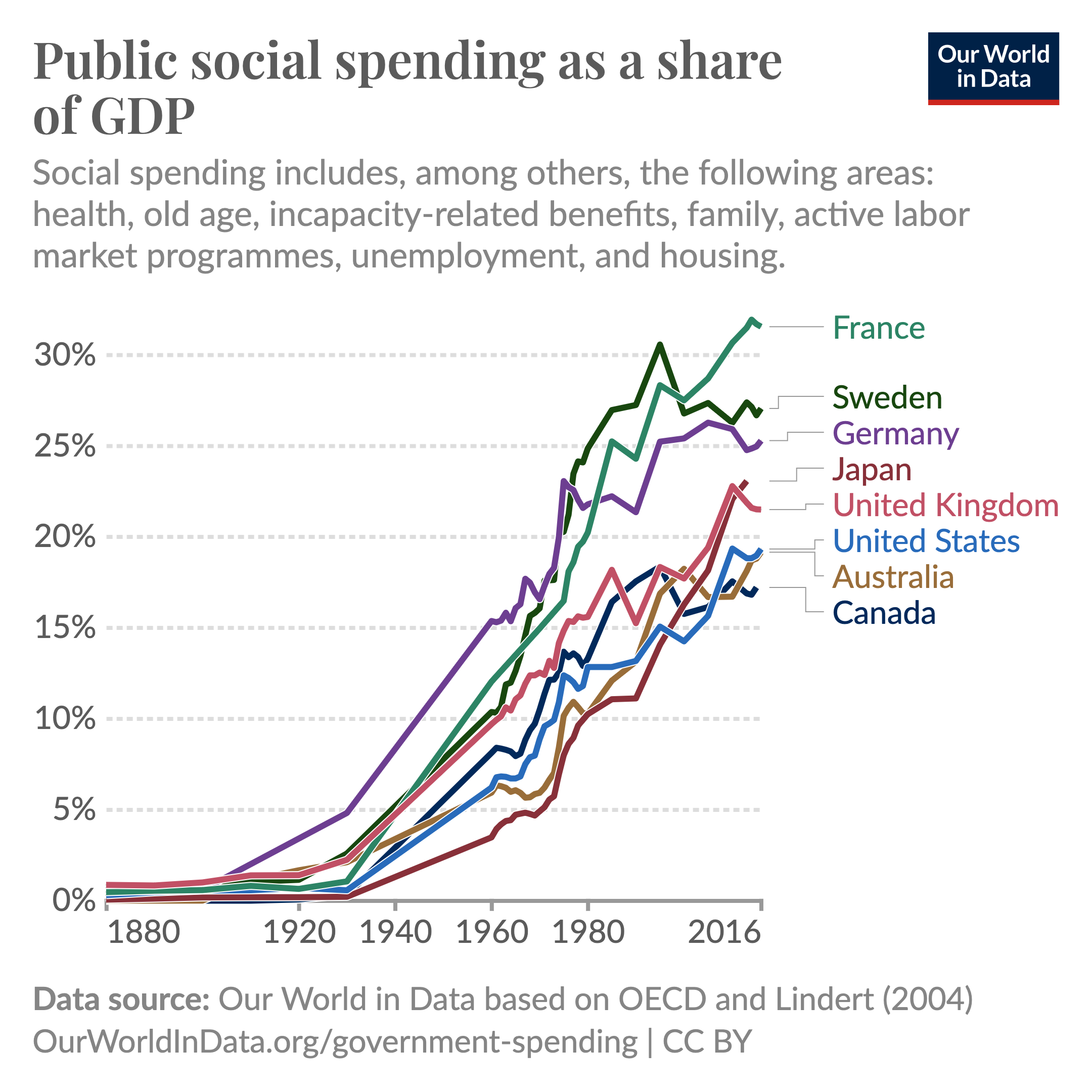
In 2022, social spending exceeded 22% of GDP across the OECD, while overall social spending has systemically risen since the beginning of the 20th century. While the early effects were strong and growth remained high, debt ultimately drove out the possibility of inevitably increasing government services. Various “corrections” can be considered (the US and UK in the 80s or Canada in the 1990s) where economic growth again outpaced historical averages, but the vast observation across most developed countries is that debt remains persistently high while the services enabled by social spending continue to decline in quality and effectiveness.
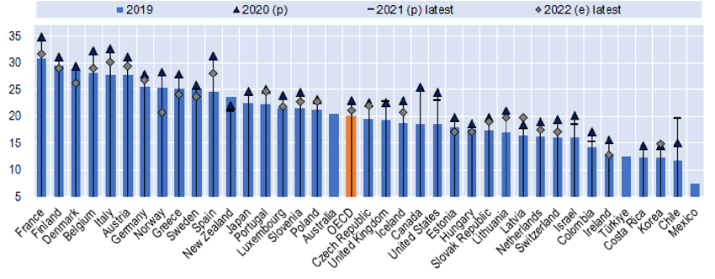
With the average GDP per capita across the OECD at around $52,000 USD, the equivalent substitution of social spending at 22% with a gross minimum income would equate to approximately $11,400 USD per year, across every age group and demographic of the population - not simply working age, elderly or the infirm.
While substitution of services may not necessarily be suitable for situations like mental and physical disabilities, where specialized care is required, various insurance schemes and clearly regulated private services could be a gradualist replacement for many of the government services that continue to decline in value. What’s more, by driving increased participation in markets, that spending would be taken down to the level of the individual citizen, meaning that they can consider whether they actually spend it on services made available to them, or otherwise spend, save or invest it in different goals.
Increasing this sort of liquidity would not only increase the overall velocity of money within a existing markets, but transform the attitudes that people have towards the services provided to them. In place of simply taking what is given, students, patients, drivers and others can take an interest in the services they purchase, while service providers are increasingly motivated to find ways to innovate and provide more value at less overall cost.
The OECD itself published a paper modelling this sort of transition with mixed results, however by the admission of its own authors, the actual modelling of this set of policies is highly dependent on modelling choices and their assumed secondary effects. In modelling these inputs, however, one does not necessarily need to undermine already existing and paid-for social insurance schemes like pensions, or services that are often funded at the local level. Consider community health or recreation centers - services which are also generally far more responsive, by nature of proximity, to their clientele.
What’s more, the original OECD study was published in 2018, prior to COVID-induced giveaways, where debt loads were lower and demographics were still somewhat rosier (only 8 years ago, mind you). In the current context, reconsidering the models might make it clear that there are actually few other ways back towards a regime of rising growth, declining costs, reduced inequality, and increased share of private market GDP.
In the realm abstract, Milton Friedman did once propose a Negative Income Tax Scheme. While shades of this have been adopted by various means including Earned Income Tax Credits and other consumption “boosters” like child benefits and the like, the net effect in its simplest form would have likely discouraged work, while a broad redistribution - though higher in expense - would provide no incentive difference on incremental income, except to provide for basic necessities and to substitute otherwise “hard-fought-for” or “hard-earned” pre-existing social benefits.
But the last and most opportunistic benefit of this sort of substitution is not to diminish the overhead of government or increase the efficiency of services - it is to devote a greater portion of existing economic activity to subsidizing aggregate demand. Why is this important? Direct transfers have been tried since the Great Depression to rectify employment crises and backstop declining prices that effectively destroy productive capacity, and in more recent years the utilization of aggressive interest rate policy as a broad tool to maintain GDP growth has had the secondary effect of inflating asset prices beyond any point of sustainability. Aggregate demand has been suffering because of the imposition of taxes, financialization and the inability to realize the efficient provision of everyday services, and increased inequality of incomes - primarily due to globalized markets - has caused oversized drag on aggregate demand such that national economies cannot continue to grow at predictable rates.
And what about redistribution of incomes going towards overseas consumption, as a further drag on “domestic” product? At least in the broad case of OECD member countries, more than 50% of global corporate profits are booked in high-income jurisdictions, so even where direct consumption more overseas, that production is often outsourced while the owners of capital - and “collectors” of profit - stay domiciled in relatively high-income countries. What’s more, it is in fact high taxes - primarily to support now-inefficient social spending - which tends to drive these sorts of characters away, so the actual net cost of this consumption shifting is relatively minimal (though ought to be studied more).
So, in context, if even a negative income tax effectively discourages work by encouraging the leisure of those with “modest tastes”, isn’t that in a sense increasing aggregate demand even more? Those people will do nothing with their time but consume, of course. The main challenge for fixing modern social policy is not to remove social policies altogether because they are “too expensive”, or try to make existing methods of service delivery more efficient (bureaucratic tendencies will creep back in). The objective of social policy, with respect to policy-makers, should be to increase the perceived rate of benefits to individuals while increasing the private share of the economy, and thus increase overall growth - upon which benefits, both perceived and actual, can continue to grow in the future. You could say that this is offering "welfare bums” a buyout (in some degree of perpetuity, mind you), but in effect, buyouts are one of the only ways that large institutions can equitably correct major financial shortfalls.