

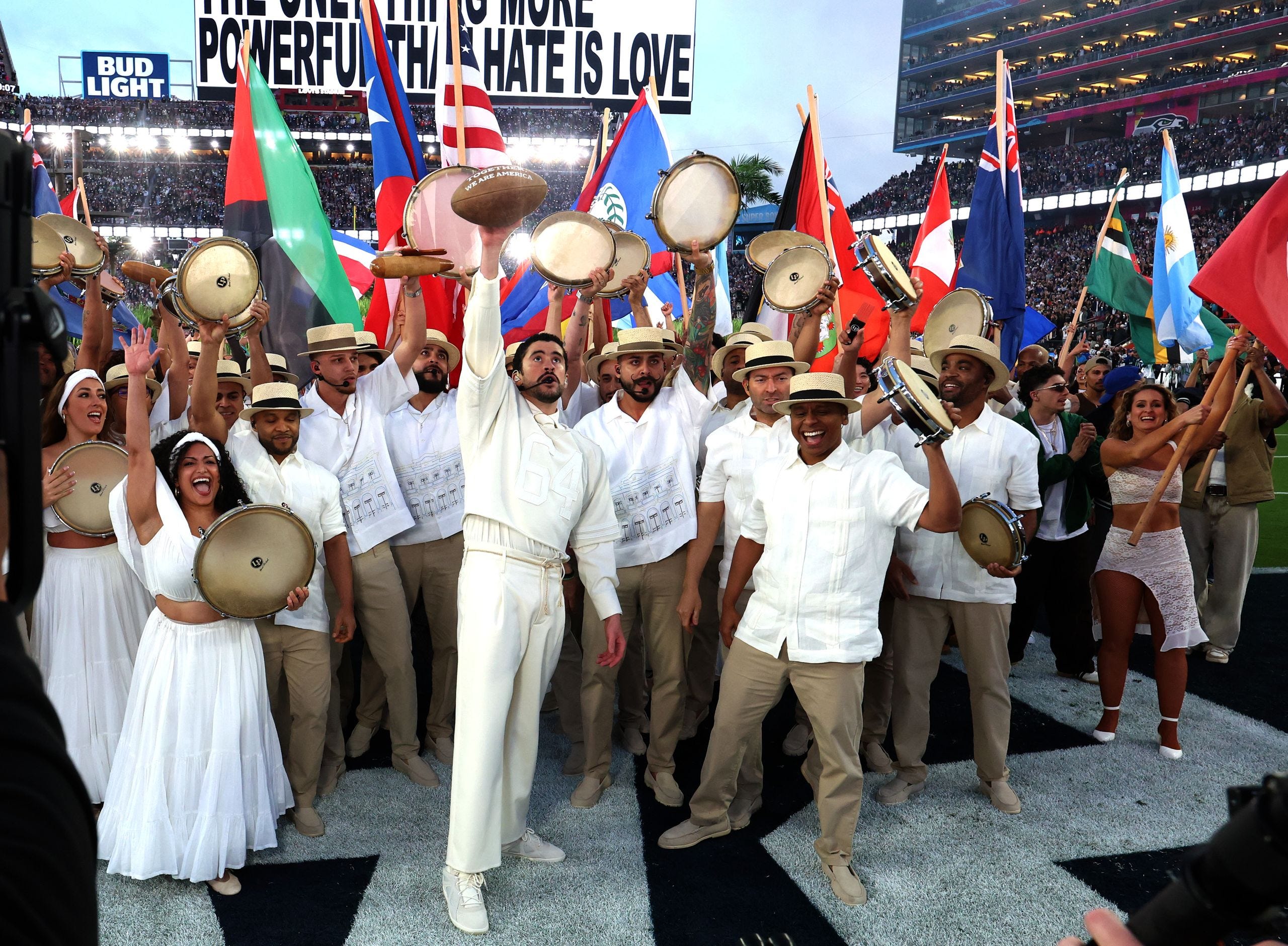
The recent Super Bowl halftime performance by Bad Bunny revealed some interesting contradictions in the modern conservative political narrative around demographic change, integration, and the nature of American Empire. These could be named thricely: 1) demographic expansion in the United States leads to cultural interchange, which 2) then drives greater co-identification within a broader political sphere and eventually serves to 3) reinforce the core over the periphery, because the core is still seen as the “center of the action”, even as the periphery is increasingly recognized as relevant to the “discourse in the core”.
It is an interesting rehash, thus, of the Monroe Doctrine, that Bad Bunny effectively waving the flag of every North American country and saying “we are all American” while in the United States at a United States sporting event nudges at a political realignment that essentially puts conservatives in control - if they were to welcome it. The modern media environment is such that whatever gets clicks, engagements, attention is what has currency, and the pop culture of the past (or “segments” of it like Kid Rock that were never tremendously popular to begin with) simply fade into irrelevance as the great mass of men take control and drive the discourse forward.
This is to say: there is no longer any such thing as “discernment” in the cultural sense. The tides of history have swept away race, class, ethnic and social distinctions in order to create an “aggregocracy”: not a democracy in which the people exercise popular sovereignty in any meaningful way, but where society has reached such a tense, advanced state of development and equilibrium that nobody is willing to really upset the apple cart, which implies that people are getting enough of what they want most of the time that there is no purpose to really be preoccupied with social change - let the tides of change come as they will.
While this seems like an appropriate attitude in the United States, which has consistently outperformed other advanced countries (not counting China here) primarily because of the reach of 1) the reach of its corporate entities, 2) the laxity of its tax structure and 3) the ability to incorporate its vassal states in expansive supply chains and economies of scale that are simply not as attainable for countries like France, Germany, Australia or the “middle powers” that would presume to stand up to Donald Trump (as Mark Carney might have it, at least).
It is in this implicit incorporation of vassal states that the United States continues to see expansion in the future, merely by leveraging an increasingly distributed division of labor - even as efforts to re-shore production persist - should the wealth of this particular nation continue to expand.
And yet, this relative placitude in its populace also makes up the same conditions within prerevolutionary France or Weimar Germany - a sort of willingness to let bygones be bygones until some precipitating event introduces a new level of chaos and destitution, and ultimately leads to the accession of a “strongman” who promises to “set things right” and “restore the nation” to its former glory.
Many would say that Trump is this figure, but he fails to actively incorporate the kind of stakeholders he’s looking for in a new social contract, and constantly accepts the tradeoffs imposed on him by the national security state (whether in the Ukraine or Israel) while executing a sort of fascist performance theatre that he is personally in no particular manner really attached to (hence ICE’s recent exit from Minnesota).
Ultimately, Trump would love to be a “lib” president in that his deepest, darkest desire seems to be for popularity (his dalliances with Jeffrey Epstein notwithstanding). In this context, he would gladly sacrifice 5 or 10% of his “white” vote in order to gain 15 or 20% with Latinos and the concomitant popularity and acclaim that go with.
From the perspective of an American Empire that may or may not be seeking more active strategic conflict with China, achieving a state of oversupply with regards to manpower (primarily from Latin American countries and principalities) would be the first step to buffeting the otherwise still replete industrial and military logistics capacity of the United States (on top of the persistently low oil prices that Trump is also doing his part to architect).
At this stage, the Trump administration is reformulating the American Empire to be better aligned to withstand the vexations of a new pole to the East, and whether Trump is getting intentional or unintentional assists from American pop culture doesn’t matter as much as whether the cultural output of this period is built simply for snacking, for passive consumption, for droll chicanery, or whether it will actually add to the “American pop canon” in such a manner that it becomes recognizably and identifiably American, or whether it simply drives the United States further down the road of ethnic balkanization and regionalization from within.