

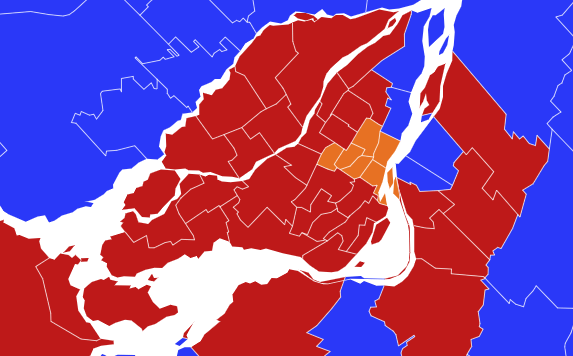
Yesterday evening’s Quebec election produced transitional and polarizing results. the Parti Quebecois (PQ), titularly sovereignist, came back to power with a strong minority government but a limited mandate for social spending or interventionism, while the previously “Third Way” autonomist CAQ gave way to this more moderate version of the PQ or the Parti Conservateur du Quebec (PCQ), the latter primarily in the greater Quebec City Area.
Autonomism has been a “third way” principle between the Federalism of the provincial Liberal Party and the Nationalism of the PQ. Initially developed by a Liberal functionary (Jean Allaire) as a response to the collapse of Canada’s Meech Lake Accords, it advocated for greater devolution of powers to the provinces in place of the emphasis on a strong federal state, but was ultimately not pursued by a political party in Quebec until Allaire later founded (and Mario Dumont led) the ADQ (Action Democratique du Quebec). The ADQ was a bright star that shone shortly, peaking with 40 seats in 2007 before collapsing, but finding broad support in the various suburban belts of Quebec around Montreal, Quebec City and Trois Rivieres, as well as more developed portions of the Monteregie and other less remote regions along the Saint Lawrence River.
Historically, this is the corridor of industrial development for Quebec and/or Lower Canada, and to this day maintains an autonomist sensibility that could be identified in part with the Patriotes Rebellion of 1837-38, which in many ways was an uprising of a Canadian petty bourgeoisie against the more established moneyed interests of the British Empire centered in Montreal.
The British Empire is long gone, but the ressentiment remains. With the rise of sovereignty, Montreal lost its status as the economic center of Canada - with many corporate headquarters and other operations moving to Toronto in the late 60s through the early 1980s - while nearly 900,000 English-speaking and anglophone-adjacent Quebecers left Quebec between 1966 to 2021. This outmigration was primarily among those who could afford and were sufficiently interested to leave - mostly those who composed the similar petty bourgeois and private sector workers that could no longer tolerate the nationalist restrictions on the function and performing of business, as well as increases in the cost of living relative incomes elsewhere.
In this same period, Montreal’s tax base was hollowed out and its infrastructure suffered. To this day, there is no end in sight. The City of Montreal maintains $14.5b in direct debt - 151% of operating revenue - with debt servicing at $1.27b, $900m in annual infrastructure maintenance shortfalls and a $7b separate maintenance deficit for Montreal’s public transit system.
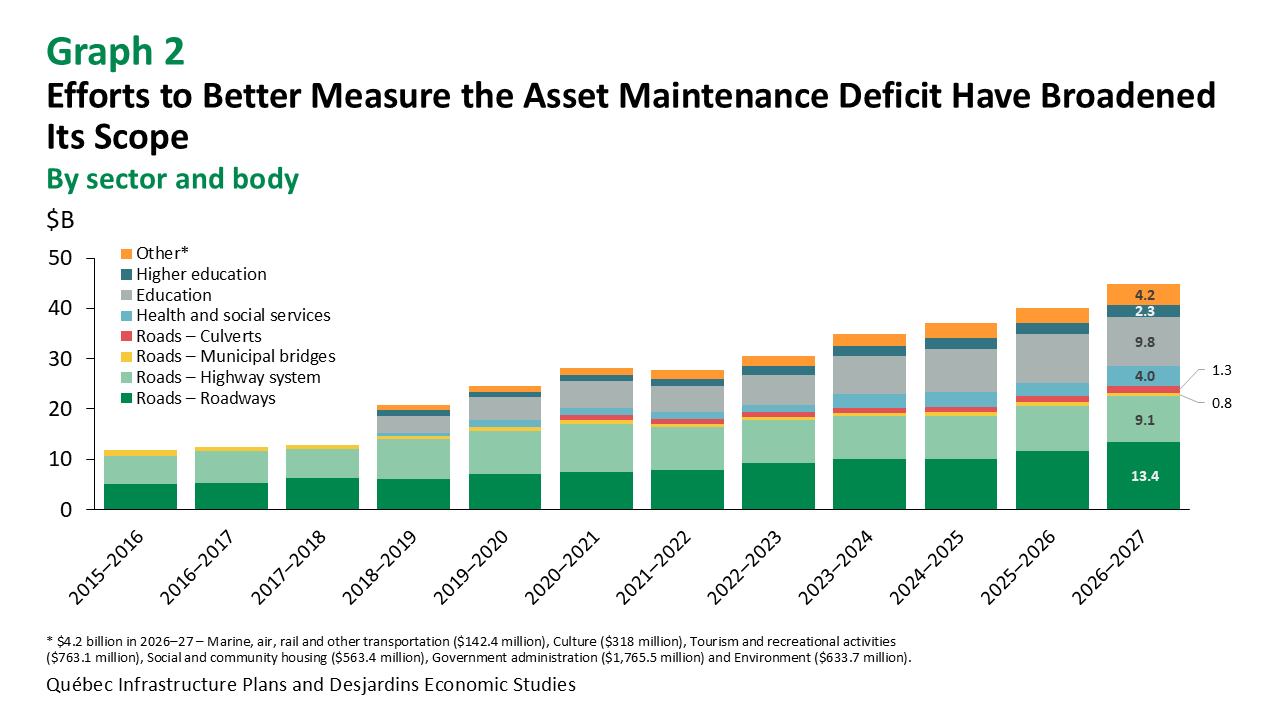
The total province of Quebec’s asset maintenance deficit now exceed $40b, 4 times more than where it was only 10 years ago, with Montreal’s much-maligned roadways as a primary driver. Most of Quebec’s new road and bridge development is already carried out by public-private partnerships, since despite pre-existing shortfalls, Quebec is already the highest-taxed jurisdiction in North America.
The current election is a wave response to the underlying fiscal irrectitude of the province, primarily driven by the Federalism v. Sovereignty debate which has distracted from the underlying economic malaise and demographic decline of the province. While the most remote regions vote PQ and the city of Montreal votes Liberal (with some, further left, Quebec Solidaire ridings), the outer suburbs in various areas - which once voted ADQ and CAQ - have now turned to the PCQ as a new potential saviour.
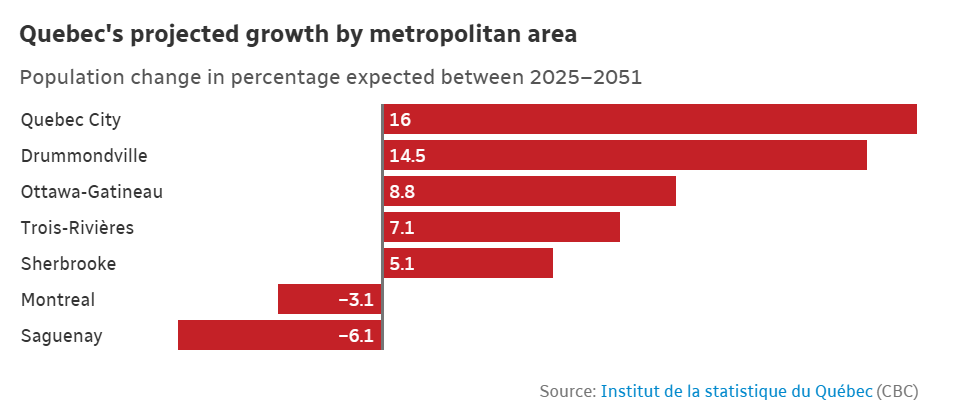
Most of the growing cities referenced above are in the upper Saint Lawrence region, and incidentally most of those areas turned to the PCQ this time around, as shown in the map below (with Montreal highlighted for relative position).
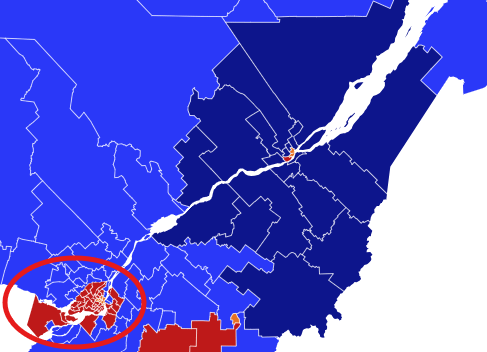
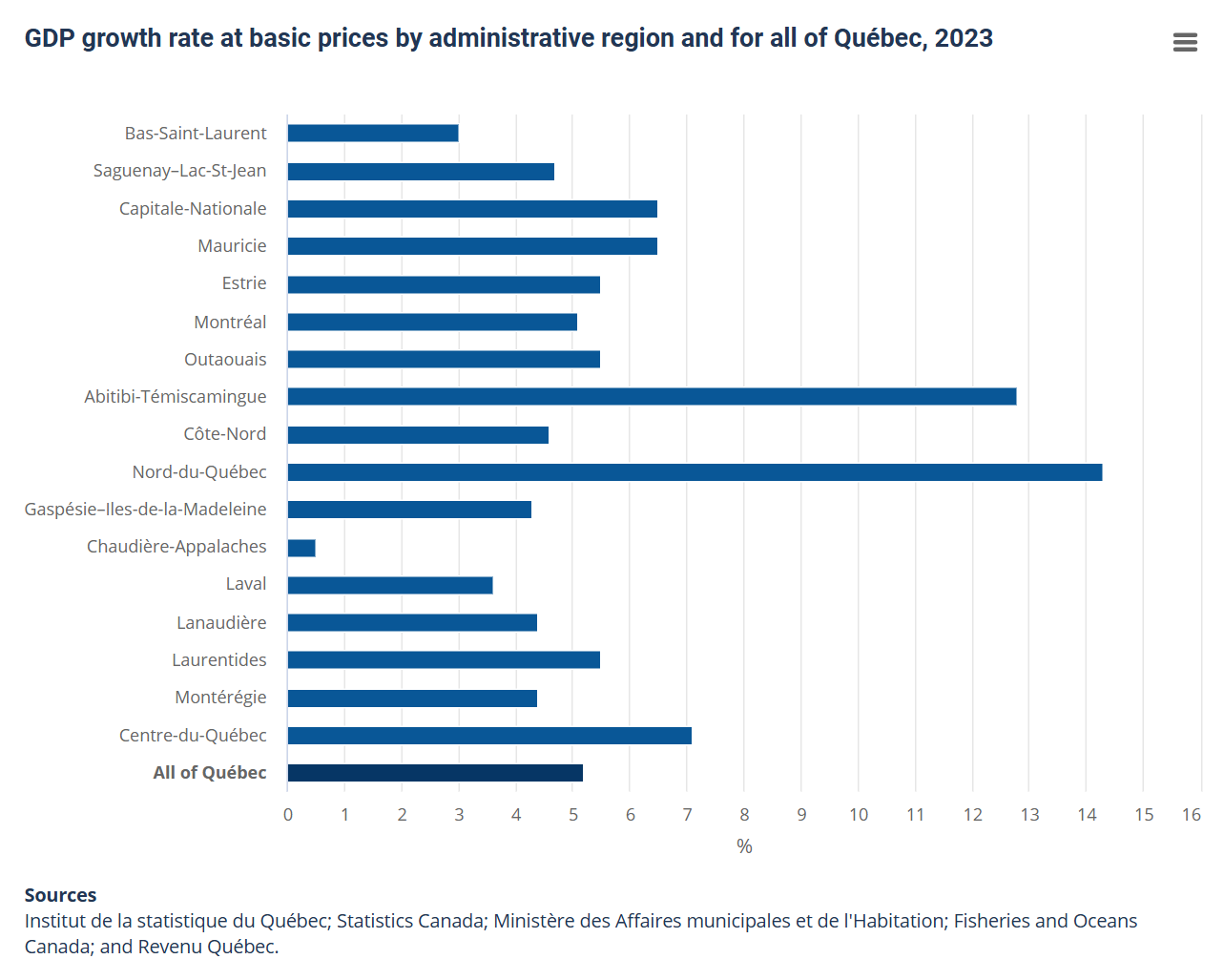
Incidentally, these are also areas where housing is more affordable, industrial policy more permissive, and actual economic growth also outpaces the provincial average.
For two previous elections (2018 and 2022), these provincial areas outside of the Island of Montreal primarily voted for the CAQ. While economic growth under the CAQ has been above the recent historical trend for Quebec, this period is in part what permitted the major infrastructural deficits on the island of Montreal (in addition to the consequences of the Charbonneau commission’s findings on corruption in Quebec’s construction industry). In the same period, Quebec has outpaced Ontario in economic growth, its nearest peer as a jurisdiction within Canada.
While the PCQ currently represents the substitution of CAQ largesse and economic interventionism with a more laissez-faire, anglophone-flirtatious commercial party, the broader implication is that Montreal is now also an economic pariah - a city left behind by decades of both generous social spending and nationalist, interventionist economic policy which drove away its most affluent, wealthy and productive demographic groups.
The leadership of the PCQ may understand this, with Eric Duhaime in his victory speech stating that anglophones should feel encouraged to “stop being a hostage to the Liberal party”. While most of Quebec’s choice reflects a desire to rein in the government’s desire to “pick winners and losers”, directionally there is a contradiction between a decline in the overall size of the provincial government while there remains a desire to increase investments in education and housing - where Quebec’s existing deficits are most flagrant outside transit infrastructure.
In the current balance of vote share - 28% for the PQ, 24% for the Liberals, nearly 21% for the PCQ and subsequently 12.4% and a remaining 13.3% for Quebec Solidaire and the CAQ respectively - a full 37% of the populace and 49 seats in the legislature voted for explicit promises of increased spending, and nearly 40 of those seats (and a large portion of that vote share) is on or adjacent to the Island of Montreal.
As of last measurement (in 2013), Montreal accounted for 49% of Quebec’s population, 53% of GDP and 50% of personal income taxes paid. In 2019, Montreal accounted for 56% of provincial GDP but only 49.6% share of GDP growth by 2023. This directional decline - which incidentally is not any different from the rest of the Quebec average in terms of overall productivity, despite being a major urban center - is walking headlong into a debt and deficit overhang which cannot be resolved without growth far in excess of what is observed in the rest of the province.
Without policy shifts, without cultural shifts, without a diminishment of the state and a fundamental reinvention of the traditional way business is done in Montreal, it is for all intents and purposes finished as a city within Quebec proper. Quebec has consistently awoken now for multiple election cycles to a pro-business, pro-growth agenda that would actually promise to resolve the fiscal contradictions brought on by the Quiet Revolution - while completely gutting the CAQ and showing a willingness to abandon parties that underperform expectations in this respect, and most of Montreal is still stuck in 1966 - for better or for worse, we can imagine the outcome that follows.