The Best Enemy Money Can Buy
Nvidia, Chinese Chips and the AI Unwind at a Precipice


AI market resistance and breakdown continues with the decline of Nvidia, which in the wake of CEO Huang’s cheating and spying allegations is trending structurally down as investors will soon realize that the unwind of much of Nvidia’s $500 billion in circular financing and self-supporting commitments will put pressure on the rest of the market to substitute for those investments.


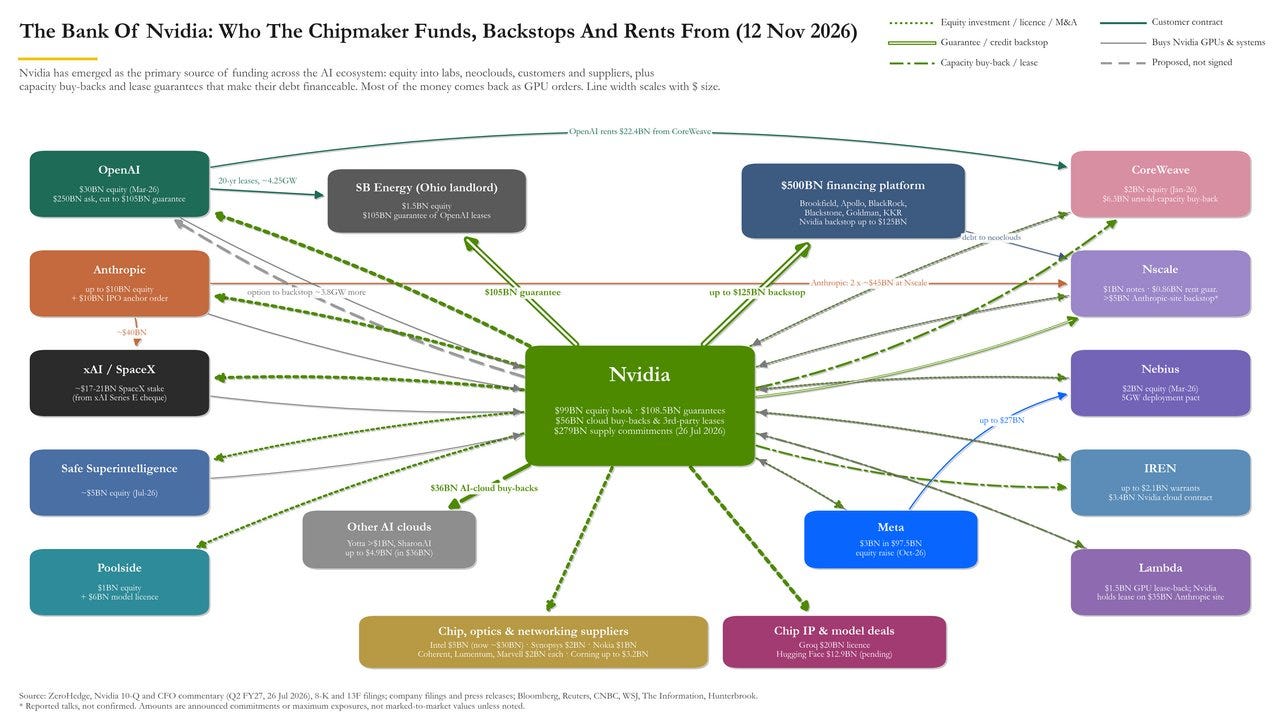
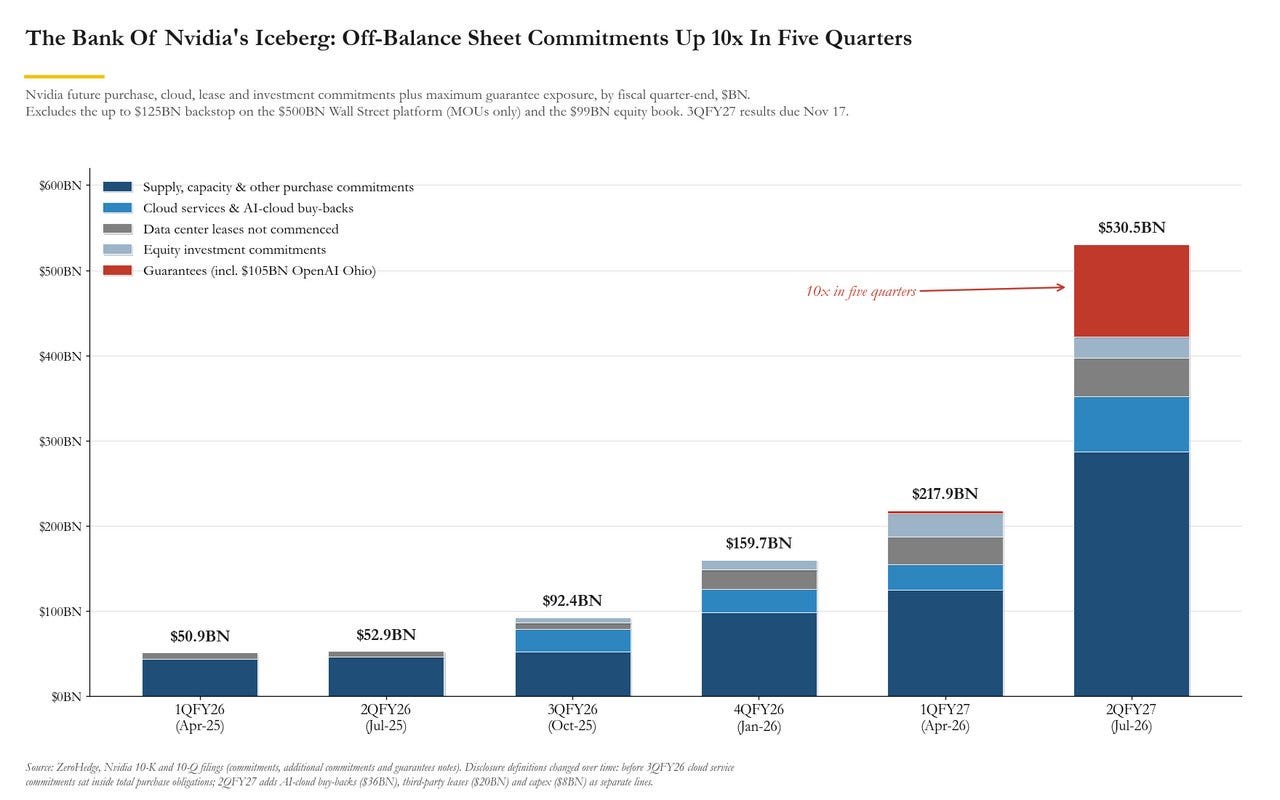
While Anthropic and OpenAI earnings drive much of the expectations for the AI market forward, the exact future liabilities are in the tens and hundreds of billions, and expected spending is in the trillions - before depreciation - to support what is potentially hundreds of billions in annual revenue. That is inasmuch the issue, however, in that while annualized run rate revenue approaches gargantuan numbers, realized quarterly revenue has only exceeded $25b as of Q3 2026 (between Open AI and Anthropic), and open-source data indicates that private model usage is decaying, or usage growth is slowing sufficiently to call into question the long-term valuation picture for these companies - the same valuation upon which the AI Capex boom has been justified.
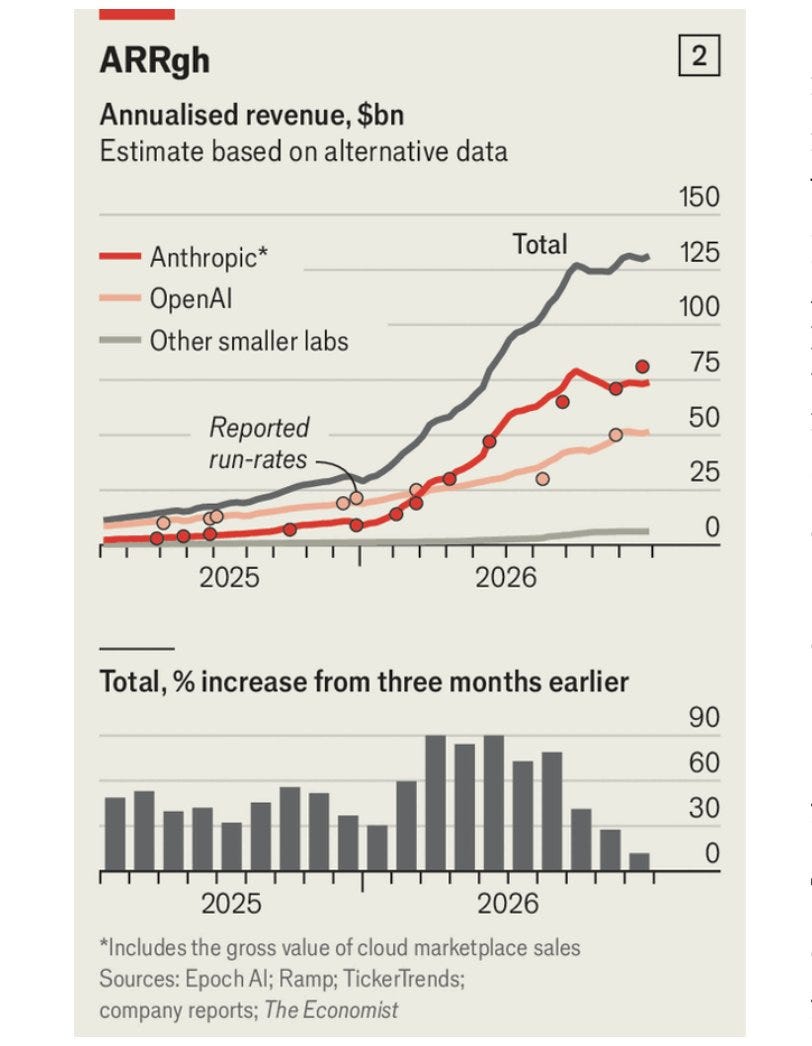


Without insider information, it is not possible to know the full story of what’s taking place at Nvidia and in the broader AI market, but the procession of AI companies towards peak valuation relative to earnings means there will be substantial limits placed on markets going forward, as investors flee from losses due to overvaluation. If, in this environment, Nvidia is forced to pull back from it’s various market commitments in order to protect its own stock, balance sheet and cashflow, the broader repercussions could collapse the AI market overall, causing other investors to pull out, costs for model providers to skyrocket, and margin compression to such an extent that - even while offloading liabilities that can in fact be shed - model company valuations will be ground to dust.
The real question is, why would Nvidia - and Jensen Huang specifically - be at the helm of this sort of enterprise? “He whom the gods would destroy, they first make mad?” And why would marital infidelity be used as a pretext for his resignation when he had, according to the latest reporting, already encountered resistance among Nvidia executives, the Commerce and Treasury department and the defense establishment in regards to suspect pass-through sales of restricted chips to Chinese interlocutors? He had for years been an advocate of open-source models, strategically a useful move to compress margins at private-model companies and ensure Nvidia chips could remain the default solution for anyone renting model capacity.
Was Huang so set on selling chips that he could “never say no” to dubious Chinese buyers? Was his first reported affair used to compromise him? Would sufficient H100, 200 and 800 chips in China ensure that Chinese models would be trained on his stock, Chinese chipmakers would be kept at competitive distance by being unable to compete with Nvidia’s supply, performance and technical flexibility? Did Huang think he had to engage China to maintain his own moat, at the cost of US national security? All of this while the expected end-use productivity gain of AI mostly boils down to the very AI capex boom that he helped to finance?
It is not possible to know what the motivation is, and perhaps even Huang is unaware, or simply felt instinctively that he was doing right by his technology, his company, his shareholders, or yes even his country (constructive engagement with China notwithstanding)? However, more important is why he was stopped in the way he was stopped, or otherwise not stopped sooner?
Towards the end of World War I, the American progressive intellectual Randolph Bourne wrote that “war is the health of the state”. In essence, the presence of significant conflict at the nation-state level allows governments to concentrate power, marshal resources, quash dissent and create a sense of unified camaraderie among its people, even if it is more in the interest of the state’s institutional structures than the people themselves.
While Bourne passed away before his thoughts on the subject could be finalized for publication, it is well known to keen observers of history that many of the strategic rivals of the “West” are actually centrally dependent on information, engineering expertise and technology transfers given to them by the west to such an extent that it is key to sustaining both the economic and military capabilities which make them an institutional threat to begin with.
How is this the case? In his 1986 book “The Best Enemy Money Can Buy”, alternative historian and economist Anthony C. Sutton (onetime fellow at the Hoover Institution, up until the publication of his most controversial writings) makes it by exploring the history of how Western engineers, entrepreneurs and investors were essential in the industrialization of the West’s primary strategic adversary at the time - the Soviet Union. In the corpus of all his works, Sutton argues that in most cases, US business activity in the Soviet Union and Nazi Germany were primarily driven by economic self-interest, regardless of moral concerns at the time or the consequences of economic developments that would come thereafter.
In “The Best Enemy Money Can Buy”, however, by the 1960s, the Soviet Union was in fact primarily dependent on technology transfers from the West - both permitted and discreet - for capital goods as varied as marine-diesel engines for their merchant navy to early semiconductors produced by the Fairchild Semiconductor and others. Corporate executives explicitly argued against tech sales restrictions, primarily because of the benefit to their bottom line, and Sutton argues in his conclusion that this does not amount to treason in the limit because US laws were not explicit enough to restrict all relevant technology transfers - particularly for “dual-use” technologies like semiconductors - and that business leaders could not be proven to understand the security risks posed by sales of their specific technologies, all while trying to make a profit.
While “blind incompetence” is the only defensible argument, there does however exist an incentive for technology transfers of all kinds to foreign adversaries: the sustainment of peer competitors sufficiently capable to justify the spending desired by the US national security apparatus, sometimes referred to as the “military industrial complex”.
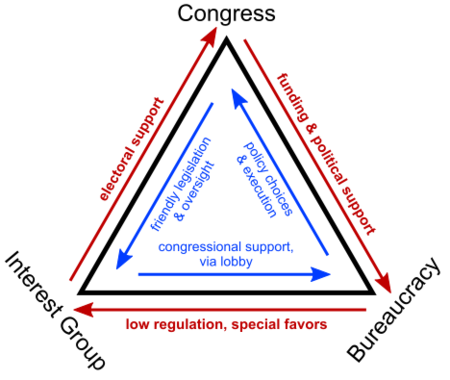
Classically, this perversion is known as the “Iron Triangle”, an observational framework developed by sociologists between the 1960s to the 1980s, to understand that in essence the US Congress functions as a mediator of patronage systems between bureaucracies and special interests - the special interests support politicians, who subsequently guarantee funding for bureaucracy who then provide otherwise lax oversight and regulation to the very special interests which fund their patrons (i.e., congress).
In this sort of system, government largesse becomes predictable where government is viewed as “the solution for everything”, because the government is in fact incompetent by design (perhaps another perversion of the intention of the Founders - yes we will abuse the word). However, in the case of the military industrial complex, who benefits from actually enforcing the rules - within the bureaucracy or elsewhere - while Jensen Huang is making a few extra billion and staving off strategic competition in China? The answer is, practically no one at all.
Whether AI has a net productivity benefit or not is of no concern here, the reality is that AI is already used in military operations: from general staff functions and military planning to the actual design and execution of raids and air strikes. By giving China a peer capacity in AI for both economic and military purposes, the entire patronage system that is driven by US Congress benefits: it permits greater intensity of competition, more sales, greater tax revenue, increased public expenditure, increased campaign financing (particularly with the laxity of current laws) and more aggressive popular concern about the “enemy across the Pacific”, in lieu of attention paid to more meaningful domestic issues.
That being said, where constructive engagement applies, allowing China to more fully participate in the “AI transformation” of the economy also encourages cheaper models, lower total cost of compute, and ultimately perhaps greater economic integration between the US, China and Taiwan (the primary manufacturing site here) in the long term. As a Taiwanese-American, it is hard to read Jensen Huang’s true intentions here, but he perhaps too had this in mind.
Anthony Sutton made accusations short of treason - only short of treason - because intent could not be proven, but perhaps incompetence is not blind. While Howard Lutnick in particular faces more scrutiny for his delaying of action in regards to illicit chip sales, there is almost no level of government where someone in fact benefits from enforcing this sort of law, because a substantial portion of the government’s funding is justified by the idea that the United States has adversaries to stave off and perhaps, one day, wars to fight as well.
Discussion about this post