

As the US midterm elections approach their final culmination, a combination of disinterest and repressed malaise persists on the Democratic side - polls have fooled them before. Despite Presidential unpopularity, Republicans will likely retain the senate, and even some on the right (Tucker Carlson notwithstanding) wonder at how Americans “self-assign” their political interests, and how that determines who they choose to vote for.
In a media ecosystem that is driven by convincing observers that there is always a story where none otherwise appears (think of the abuse of the term “quietly” in daily online headlines), it is important to remember that the founding culture of the United States most closely approximates the state of 17th century England, previewing and foreboding the English Civil War. In that conflict, Royalist and Parlementarians battled it out to determine the legitimacy of the crown, and yet despite the Interregnum of Cromwell, the Crown was ultimately restored.
File that under “some things never change”? The reality is that the English Civil War proved pure parliamentarism was essential impossible. Cromwell himself ruled as somewhat of a dictator, and the constant demands of government upon the people led to limited government by return of the form of Divine Right.
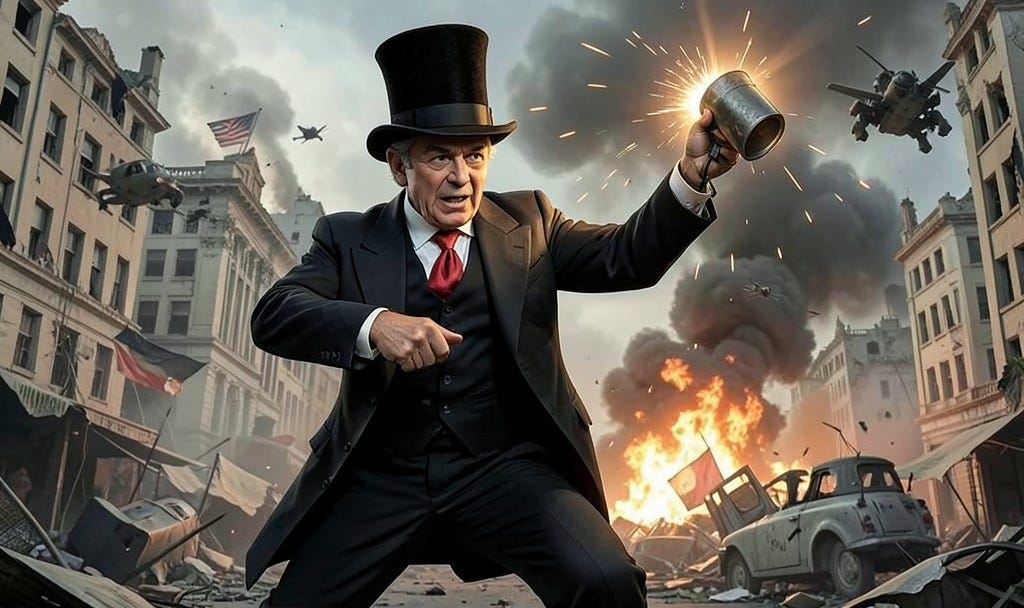
What does this have to do with the discourse today? Well, according to so many on both the left and the right, Trump is in fact a sort of “King”, and so these sorts of days are a time - much like an All Fool’s Day (“if voting could change something, it would be illegal”) - where the population can register their discontent without blowing the whole system down.
And so what is the source of that discontent? Decidedly: 1) The Iran War, 2) The AI Bubble and 3) incrementally higher fuel prices. These combined costs simply show a sense of mismanagement without a fundamentally systemic failure taking place, which is actually a recent historical exception for the goings-on of the United States Capitol. GDP growth is still above 3%. Strong private investment and stabilization in many prices - even if not important ones like fuel - indicate that the consumer knows something is wrong, knows that the government is on some level corrupt and incompetent, but is at least far enough out of the way to avoid irritating them too much.
Trump in many ways allowed for this by making the Iran War a creeping-though-limited-aims conflict. Strikes in 2025 only led to 12 days of fighting - enough for Americans to almost forgot had even happened by the time bombs starting dropping in 2026. Soothing of the conflict (without real resolution) prior to the 4th of July meant that Americans could in some sense “have their cake and eat it too” - it would only cost them 20% more to drive to wherever the cake was.
Perhaps of tertiary importance, but still relevant, is that US debt-to-GDP continues to experience a sort of odd plateau following the “Big Beautiful Bill”.
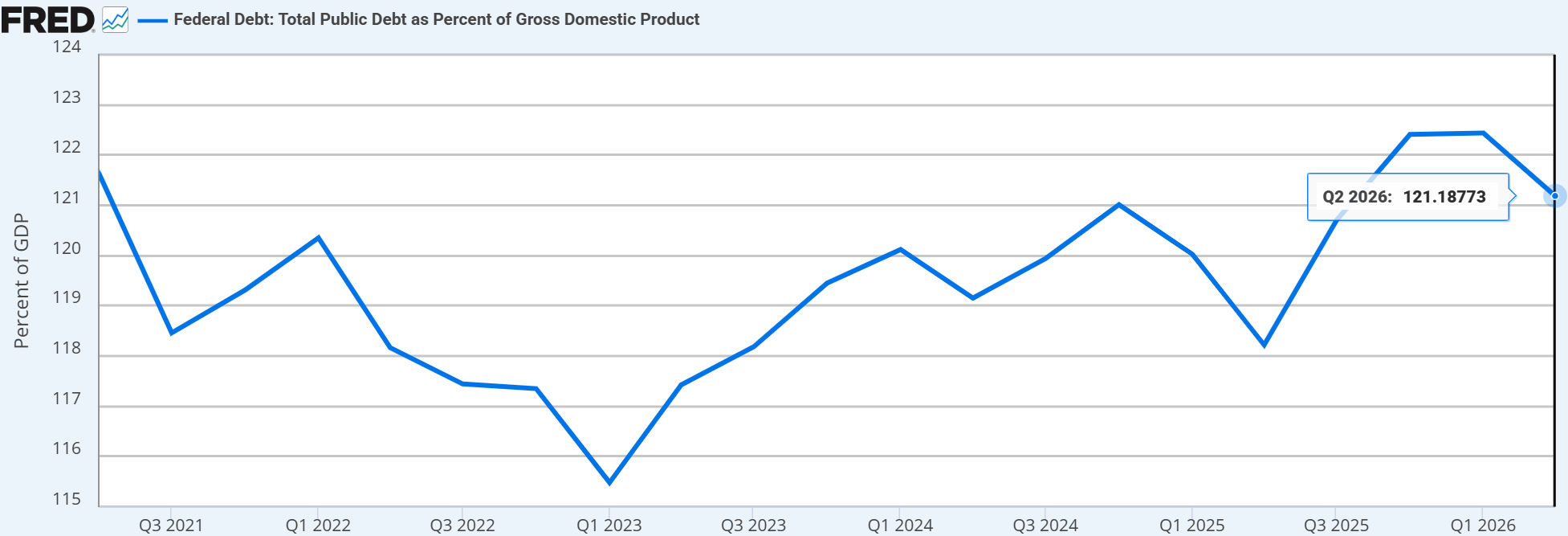
The median voter is rarely considering economic statistics over “gut feeling”, but the indications are that as growth increases, debt decreases and inflation otherwise moderates, the US is entering the kind of free-market goldilocks period which only a Democrat could spoil.
And as the avatar of that sort of spoilage are candidates like Abdul El-Sayed. Yes, there is Islamophobia in the United States. Yes, moderate democrats are not ready for “Real Socialism” and will undermine it at every turn. And yes, currently he has enough of a lead that he is still likely to win, but it comes at the resistance of what should otherwise be a resounding victory, and if Republicans hold in Maine, Texas and Ohio - which they are won’t to do - then a Senate majority the Democrats will have not.
The issue is not who he is or what he is but what is conveyed about his - and the Democratic Party’s - attitude towards power. El-Sayed did align with Hasan Piker to win the primary, most definitely an absolutist of a certain stripe, but when confronted with milquetoast Mike Rogers - particularly among the urban industrial black community in Michigan - the sort of out-and-out revolutionary politics El-Sayed practices, including attacking Israel when politically it is at its weakest in a long while, sows distrust in a mainline conservative, voluntarist midwestern population that is not afraid of a little status-quo-skepticism, but also dislikes when individuals who are from some sort of elite also bristle at the idea that they might face the same scrutiny.
In a sense, Mike Rogers in comportment and outlook, is more prone to resembling the voter base, and even if he too has issues with corruption and incompetence, he can be perceived as more honest about his motivation - even if there are questions about healthcare and tax reform, or a more superficial relationship with MAGA and tariffs. The motivations of someone who admits some degree of their own self interest can typically fall less into question than someone who pretends they don’t have self-interest at all. This doesn’t imply that El-Sayed would not necessarily be a better Senator or a more effective representative, but he affected himself as different before pretending to act like he was the same as the voters, while Mike Rogers is in fact just like the voters - middling - and that is something many are willing to admit.
In the balance of this is the “black vote”, which as a block only goes about 7% to Rogers, but simultaneously has been so beholden to Union Democrats and such a fundamental component to Democrat turnout that any moderate dissolution of that constitutes a total disaster. Michigan has tended further right in recent years, like much of the Midwest, as Trump and Co. have made inroads with Unionists and industrial labor - mostly white but in some cases quite diverse - and Republicanism has overcome the stain of Nixon-and-Atwater era “dogwhistle” politics (for some, not all, of course). Why would a white, middle-aged Republican appeal more to a “black” Michigander than a young-gun public health doctor of Egyptian extraction? Familiarity would play a part, and perhaps a lack of outright “black” representation would imply that trust has not yet been earned. For just enough of them (read: very few), Mike Rogers could be the devil they know, as they treat an entire system with skepticism and only happen to vote Democrat as coincidence.
And where these complicating factors disappears, and the economy continues to grow (something industrial laborers have been known to prefer), one can return to the English Civil War and ask: “who was more honest about what they intended to do with the power bestowed them? The Crown, or Cromwell?”
The answer is obvious enough, primarily with the benefit of hindsight, but in American culture the sense of equity without perfect equality is a primary driver of equilibrium - free of kings, but yes sometimes absolutist power can be acceptable, as long as those absolutists are honest with themselves.