

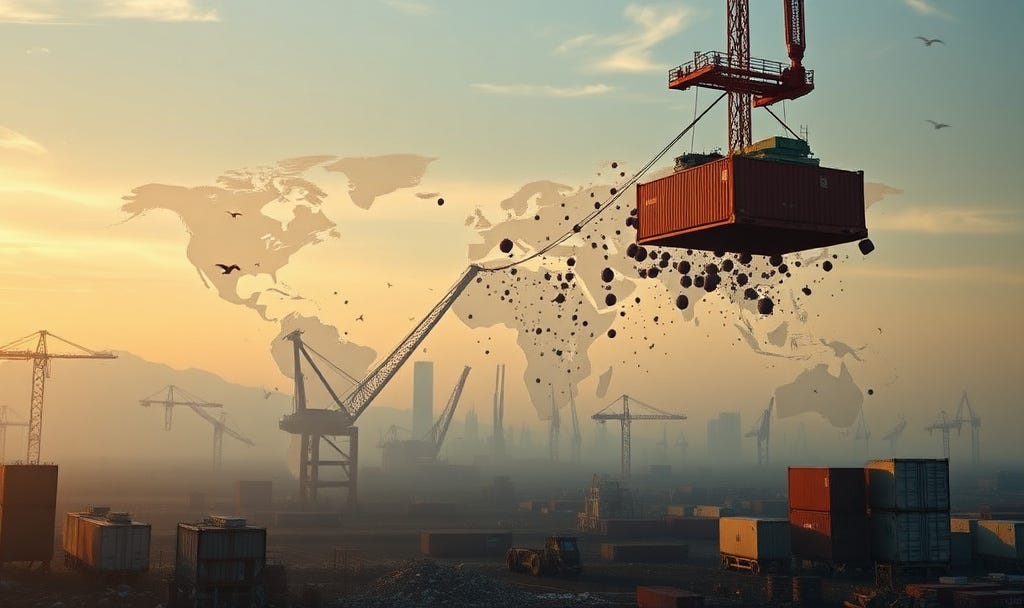
Paul Krugman, bete-noire of anti-liberals and New York Times haters everywhere, rose to prominence in part due to his “New Trade Theory” which indicated that while countries can concentrate their supply chains into the production of particular goods, effects of consumer preference, product differentiation, diminishing marginal returns and a preference for home markets all indicate that while trade can become globalized, the global economy itself may never become a thoroughly integrated entity - at least as long as identity itself is not fully globalized as well.
In many ways, the current global vivisection of supply chains - primarily between the United States, China and Russia, but complicated by Iran and the EU - may increase the domestic production of certain goods while also increasing the propensity to trade critical goods in certain sectors. Russia and Iran must export energy to survive, whereas China must export low and medium-value-added manufactured goods and the EU must continue to export machine tools, pharmaceuticals, and other high value-added but also largely stagnant consumption items.
As far as the United States goes, it can continue to export food, agriculture and weapons, but it primarily relies on consumption of all other goods from foreign nations, the profits of said consumption then being recycled into US financial markets. This is in fact the only way such a small proportion of the global population can sustain its pre-eminence in global wealth, and yet the United States is now in the process of outsourcing the work of sustaining the global security regime (maritime trade, anti-proliferation and concentration of financial markets) that has made this possible.
As this scaffolding is reconfigured, secondary effects will persist for a generation or more, but the real impact is primarily a question of identity. Specifically, the concept of “home market preference” is in fact expensive where the technology otherwise exists to hyper-specialize every aspect of the global supply chain. The Division of Labor isn’t just on steroids, but speedballs, booze and Vicodin, just trying to go up and down with the waves and currents of the earth while concentrated resource, energy and manufacturing capacity will likely be the only way to have a hope of keeping up - even as the global population plateaus, people will still consume more.
Since this is a challenge for achieving a maximum of “peace and prosperity”, excluding underlying inequalities, and the possibility of new technologies to change geographic trends, the question of what it means to have a national identity is actually at the core of whether it is possible to ultimately live in peace.
Why is this the case? Russia is fighting ultimately not just for some territory to its West, but for what it means to be Russian as opposed to European. China is fighting for its own culture, still nursing wounds in the wake of the Century of Humiliation. The United States, in many instances, has a culture defined by isolationism, anti-internationalism and hyper-individualism that is on some level simply cognitively incompatible with more communitarian social outlooks found in the global south and East.
Europe is in some sense the most cosmopolitan and capable of merging complex global identities together while maintaining a meaningful core, but it is also selective, discriminating, and understanding the lingua franca of one nation or another’s way of life takes time, breathing room, and a willingness to let go of one’s own past (in love for another, of course).
In this context, we have to question what it means to even have a “global economy”. We can view cheap goods from overseas, whether energy, low or high-value added, as a sort of externality that accelerates or otherwise creates bottlenecks on the development of individual nations, and this has a downstream impact on various small and regional powers, whether in the Americas, Africa, the Middle East or Southeast Asia.
It is unlikely that all this preparation for the future actually makes things any different. While “the strong do what they may and the weak suffer what they must”, the actual cost of building meaningful domestic capacity is far more expensive than simply “being prepared to do so”, and in that preparation - much like the USSR’s perpetual war mobilization which cost it so much economic efficiency - may in the long run be too excessive for many nations, where their adversary may not even particularly benefit from a conflict coming to fruition.
So while nation’s like China would easily take Taiwan if there was no cost to doing so, a cost clearly remains, and what is the benefit of doing taking action where trade and integration already exist? If the benefit is to be a center of power, that can be well and good, but ultimately what increases prosperity for local states is to be a center of capital, and this can be achieved by financing conquest, but may actually be discouraged by conquest itself.