

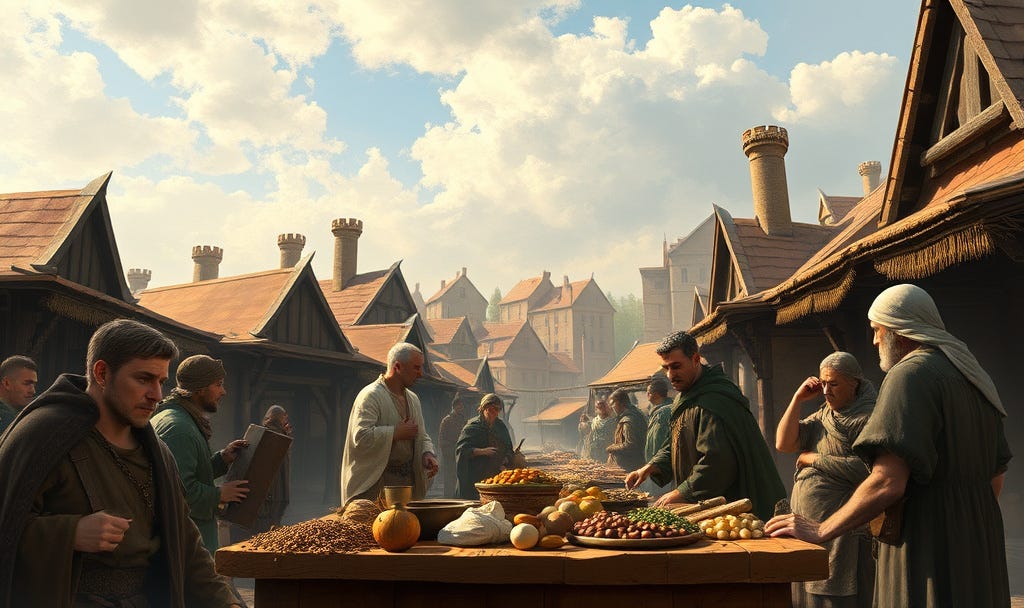
Prior to the development of more robust ocean-going commerce in the late 15th century, Europe was typified by medieval fiefdoms, lords, knights, kinship bonds and clans, church tribute, and the proliferation of feasts and local festivals which maintained a strong social fabric to the exclusion of what was otherwise considered slow economic development - particularly in the wake of the Black Plague.
It was in part the disruption of the Plague which led to innovations in agricultural methods, increases in total productivity and the greater investment of time in artisanal trades an the improvement of manufactured goods - so much so that Europe did become the research lab for innovations like gunpowder, printing and other technologies from the East that hadn’t found suitable mechanics for growth in their regions of origin.
So in the process of exploring the world - primarily for the development of commerce - we would understand that Europe has become it’s “not self” (to borrow a Joycean phrase). This is the kind of not self, or not feeling thyself, which typifies the malaise, the slow reproduction, the confrontation with global multiculturalism, and the guilt over the history of the slave trade, colonization, neocolonialism, various total wars and so on, which has led a genus of the species to go from “not self” to perhaps “not exist at all”.
What is it, perhaps, in the “seeds of this history”, that can restore a sense of vitality? A basis of common understanding and a willingness to exchange again on equal, confident footing with the outside world? Ultimately these are forms of free association. Historically these may be guilds or civic societies, and in many ways the modern corporation is a structural descendent of the guilds of old, but now the corporation has consumed so much of the natural life of man that the associations it offers don’t enrich life - one doesn’t even see “company towns” anymore, they’re simply too expensive to support, and people know as soon as it gets too costly, the jobs would be shipped overseas forthwith.
Corporations at one time invested in their workforces because they needed a growing-yet-captive labor supply. This problematization meant that if they could capture their labor force with enough incentives, they could guarantee the production needed to meet the growing global demand that was found in the postwar “Golden Age of Capitalism”. We know that by the procession of the division of labor, guilds expanded to corporations and eventually overseas trade colonies emerged, which with time formed the need for new governments and colonial administration, but now we are attending the unwinding of this expansion, because the global population is expected to peak in the next 30-40 years, and even with its peaking, it’s unlikely that it will command ordinately greater capital intensity than what is already the case today (primarily limited by credible institutional development in the global south).
So where does western society go? Is it simply a low tax, low regulation regime which will drive a return to the private forms of association that seem to create greater dynamism and productivity? The answer is probably yes, but it is also in denying the “quest for security” that typifies the unwillingness to engage in meaningful work that we will perhaps outgrow the doldrums of the late information age, and see greater industrial expansion, the settling of new lands (including those beyond the atmosphere) and even wars of conquest and expansion - rather than simply strategic incompatibility.
It is not to say that these are good things, but based on the malaise and passivity we see today, is there possibly a better means to channel our energy overall? The social consequences of this are simple: enclave politics, but one that doesn’t necessarily come in direct conflict with multiculturalism - at least as affluent liberals would have it. The development of US suburbs prefigured this in the popular imagination by offering upwardly mobile, previously working class professionals and white-collar works the ability to find “clean, safe, spacious, affordable” accommodations, and in many cases that led the generations which followed to pursue “urbanism and walkable cities”, which by liberal definitions of the past may be a euphemistic vanguard for fascism.
The Great Recession led to the impoverishment of US suburbs, and in many ways that increased urbanism of the rich has contributed to lower birth rates (by virtue of there being less empty space to fill with children). With that in mind, enclave politics will probably generate greater prodigiousness in exurbs, homestead regions, or urban communal organizations (there would require more ethnic homogeneity than any to be sustained). Government policy should “do no harm” to these contexts if it wishes to maintain the vitality of these initiatives, lest like the suburbs, the perverse incentives and tax benefits created led to “glut” and the subsequent impoverishment we see today.