


The “Washington Consensus” began in the 1980s as an assemblage of pro-market, pro-privatization and fiscally conservative policies aimed to drive trade and growth between the newly supply-side-dominated developed economies in the United States and UK and the Global South, primarily by adoption of reforms in Latin America. It culminated in many policy shifts (including privatization of state assets) in the late 1990s and early 2000s in Latin America, but gradually fell out of favor with the arrival of the 2008 Financial Crisis and the consequences of the global recession that followed, which included the acceleration of China’s state capitalist development model - and the accumulation of the mountains of debt that go with it.
The division of labor, by its nature, produces some kind of stratification. While operating purely on market principles can be good for growth, the apparent differences (and physical distances) between high-value-added and low-value-added labor can 1) first create a sense of excessive inequality and 2) the conditions for revolution, if played out too long. While specialization produces economic growth and promotes the accumulation of wealth and the development of prosperity, the tradeoffs it imposes where it does not lead to an incremental increase in the standard of living create the very have-nots which drive societies towards acceleration or decline.
Consider, for instance, the Uber driver or the DoorDash deliverer. In Western countries they are often immigrants. They may view the job as desirable to the current conditions in their home country, but are they truly better off than where they would have been in their country prior to the development of global markets?
Similar questions can be asked of middle classes and industrial labor in the West. These groups once lived “high on the hog”, but have seen their labor offshored and have been forced to respond by taking on lower-paid jobs or turning to crime or welfare, where they otherwise would have continued to lead more meaningful and productive lives.
Ultimately, it is the redistribution of wages in the global economic system, and the increased mobility of capital and people as a result, that has driven increased stratification, polarization and political instability in the West. The argument for this has been that wages had grown unsustainable by the 1970s, and cheap goods substitute sufficiently what Western laborers have otherwise lost on the factory floor, but the signs of physical, moral and social decline are too numerous to be ignored.
By that same token, is general social welfare, administered by bloated state bureaucracies and forcing compliance against innumerable regulations, really a solution for the condition of most Western countries today?
Indeed, many laborers may crave more security, but it comes at the cost of growth. Today, the United States is pulling away from the rest of the developed world in overall growth, not simply despite but because of its absence of an overdeveloped welfare state. This could be a consequence of Americans working longer hours, realizing less productivity per hour worked than some Western European nations, and the general high price of rents, goods and services forcing Americans to work more, but the United States is not totally without a welfare state, and many of its state governments also provide somewhat “generous” welfare schemes.
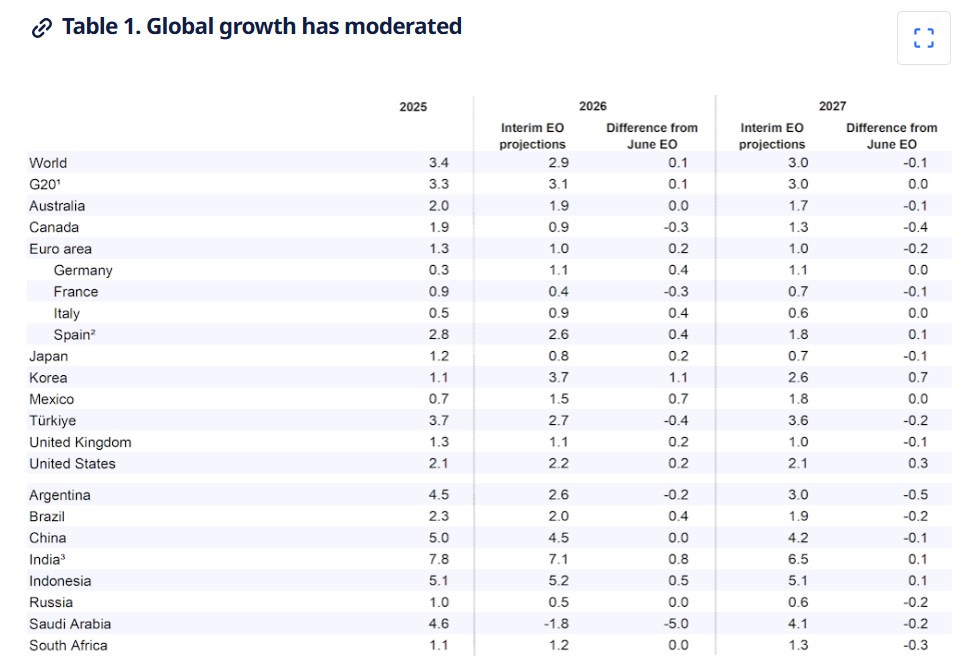
source: https://www.oecd.org/en/publications/2026/09/oecd-economic-outlook-interim-report-september-2026_8312492f/full-report.html
The issue of stability comes in that the value of labor in the West has been devalued by that in the East, mostly Southern China and Southeast Asia, and the longer term consequences of this have been a decline in the demographics of both poles as well as increased rates of public debt, occurrences of chronic health disorders and decreased measures of life satisfaction.
Sustainability economics has centered the idea of environmental sustainability, but by most human health and wellbeing measures, the actual sustainability of current labor supplies are also diminishing. While nations employ specific welfare policies with comprehensive industrial policies to avoid the devaluation of domestic labor in a globalized system, strong national boundaries ultimately reverse the prosperity generated by such systems. The goal of revisiting the Washington Consensus - which has fallen out of repute, but without an apparent heir - should not be to restore the emphasis on trade liberalization and diminish state-owned enterprises, but instead add a new emphasis on the appreciation of the value of labor and the substitution of state services with direct income benefits that reverse the negative effects global trade systems have on local wages.
It is not sorely of note that liberalization, property rights and the reduction of trade restrictions are mentioned through the Consensus’ original “tenets” (they are merely observed, not concrete), however “democracy” is not mentioned a single time. This is perhaps a consequence of the “end of history” mindset which prevailed towards the end of the Cold War, where “democracy” had by all observations been the victor. As time has worn on, democratic values and attitudes have eroded, and even younger generations are looking to it as a distraction from simply evaluating a politics of short-term outcomes.
Democracy is not a value above all others, but it holds tremendous benefit in that it can produce highly predictable social circumstances in good times, and in bad times can degrade to oligarchy, corruption, demagoguery and revolution - history even had a few examples of this before the 19th century. But the position of most small-government rightists has been to assume that welfare states simply need to be abolished altogether for prosperity to return. For some communities - even countries - this would be the equivalent of quitting heroin cold-turkey: it would both produce wild and vicious externalities, and in the long-run risk swinging back to even worse consequences, or a total collapse of state capacity for things even libertarians believe governments should administer (i.e. roads, courts, armies and the like).
The benefit of revisiting the Washington Consensus with an eye for correcting labor imbalances - and the democratic deficits that follow - are not just for short-term correctives, either better fiscal positions or improved social conditions. They should be for long-term security: states use and misuse their power in order to preserve their status, and central institutions will use services at their disposal to coerce large populations into a sense of common identity, only to foolishly expend that for institutional gain. Such was the case in World War I, where courage and national pride ended up as wreaths on a sacrificial altar, tens of millions being slaughtered for minimal changes in national borders, and only a second great war and cold war to follow.
Today, many in Russia regret the fall of the Soviet Union and wish to some degree for its return. It is a matter of CCP policy to rectify the ills brought on by China’s “Century of Humiliation”. More westerners practice a form of identitarian nationalism which can only wreak destruction on the races who practice it, as was the case of German National Socialism. It is not possible for every country in the world to be on some level aggrieved and blame every other country for its woes. This is in fact exclusively a path to mutual annihilation.
Those who believe in limited government, private property, the rule of law and mutual benefit for trade, free exchange and free association need to dismantle the cornerstones of state power, renegade nationalism and ethnic absolutism, one brick at a time, and the primary animator here is state benefits. Country by country, they must be converted to cash or redirect redistribution - not manifested through services which the state can ultimately use for coercion - and by that means they can also be “right-sized” in the future, whether by converging globally through a more equitable-but-improving standard of living, or minimized as private productivity begins to outweigh the benefits of big government’s “do it for you” modus operandi. There is no endgame where each side can only consider its own interests - only mutually assured destruction.