

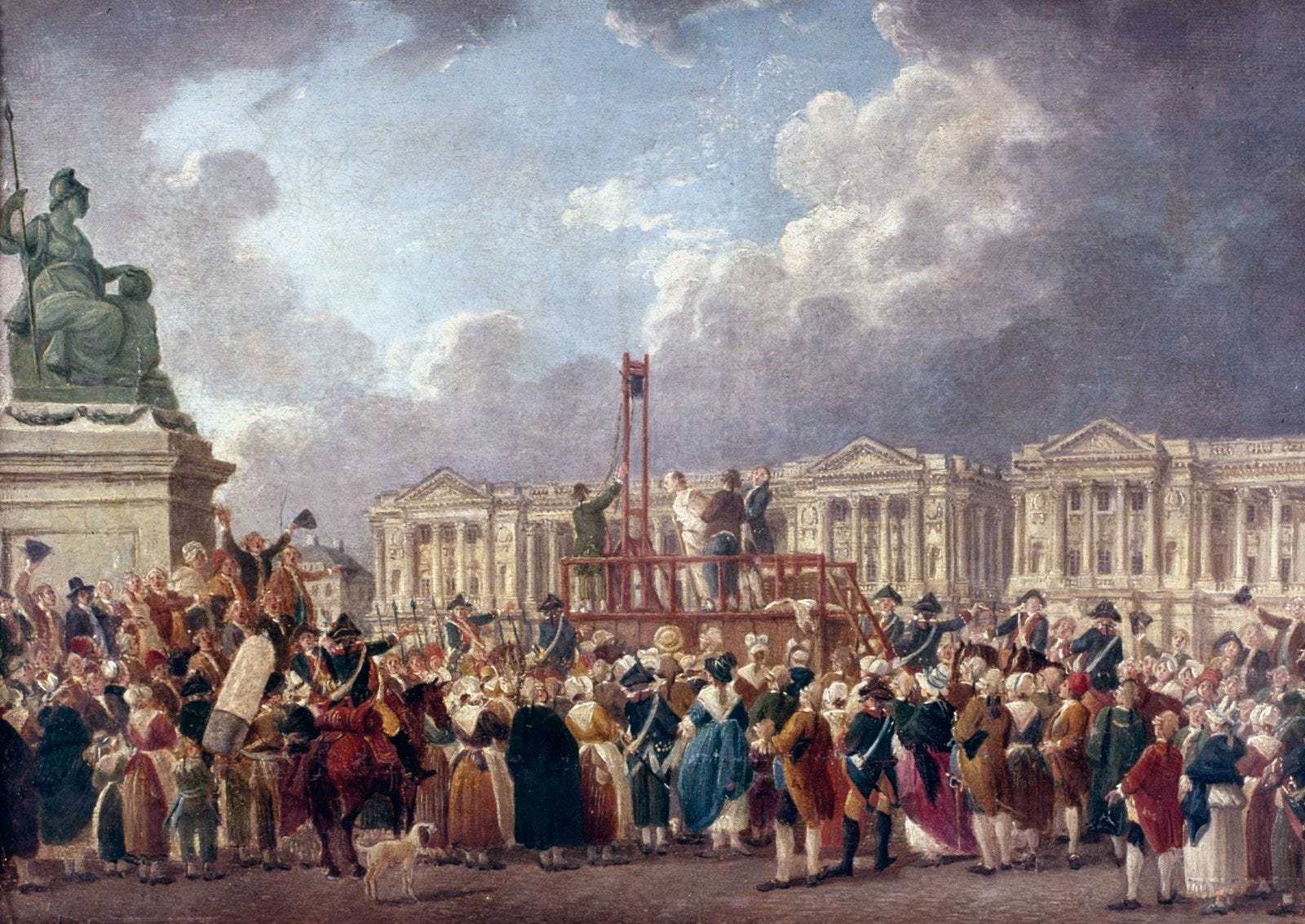
In a recent conversation with a friend, he had affirmed his happiness that Nvidia’s relative valuation would remain high, and that would have a broader benefit to his stock portfolio. Upon the reinstatement of Jensen Huang, he was of course pleasantly pleased, but I encouraged him to cash out and move to Bermuda before 2028 rolled around, to which he responded: “You mean when the Tribunals start?”
The reality is that the blatant corruption and manipulation exhibited by the Trump Administration in the case of the AI “boom” and its active participation in assuring Nvidia’s board there would be no significant prosecutions if Huang was to return are ultimately signifiers of a broader environment of malaise, degradation and neglect in the rule of law that no one administration can be fully blamed for.
Democrat administrations have for years weaponized prosecutorial mechanisms to target political adversaries and their affiliates (not in the least Donald Trump following his first term) and Republicans have blindly looked the other way on violations of basic human rights, whether it is the justifications for the war in Iraq, extrajudicial interrogation techniques and the various outcomes of the financial crisis.
The fact that a US administration is today taking a direct hand in sustaining an otherwise unsustainable asset bubble should come as no surprise given the history of dot-com, the housing market, defense contractors, private credit and leveraged finance, but with respect to AI, the gains are so concentrated and the margins are so thin that even the US Congress of all places is no longer able to look the other way.
It is entirely possible that the liberal and conservative moderates, mainline, old-hat Democrats and Republicans are growing upset simply because they haven’t been privy to the appropriate buys on the wild swings in Nvidia’s stock price, but if Congress is a racket, for the system to continue to work, it must also of course receive its due.
And this due is entirely too necessary when considering the obvious facts: In July of 2025 - the last instance of direct reporting - 22% of Nvidia’s revenue came from Singaporean entities. Even by April of 2025, Trump Tech Bro oft-“Insider” Chamath Palihapitiya pointed out that nearly 50% of all of Nvidia’s revenue was from Chinese or China-adjacent entities, and while no clear massive data center capacity was being built in Singapore, one could only assume that entities there were being configured as pass-through’s to China.

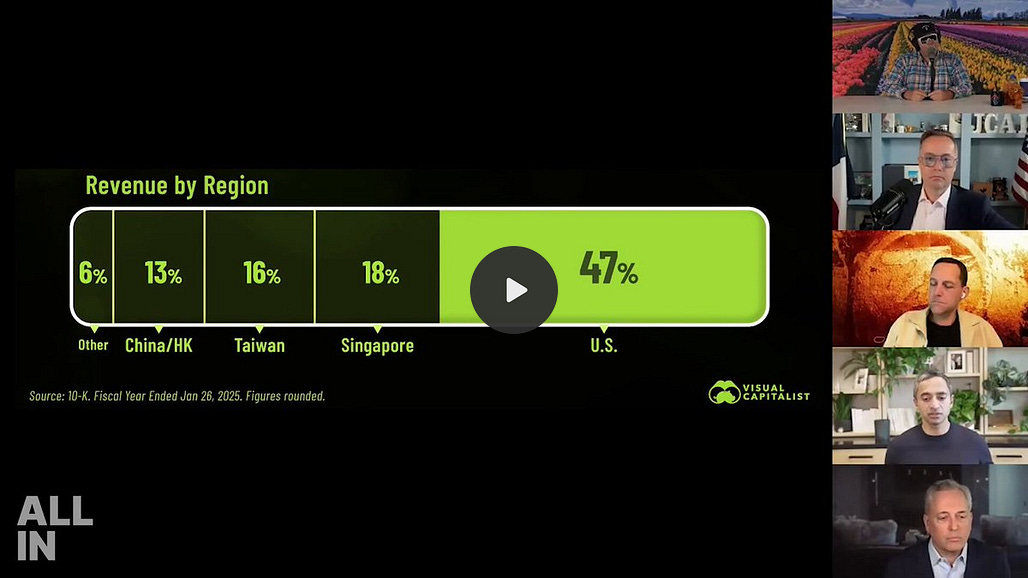
Since Nvidia stopped reporting the geography of their revenue following these sorts of critiques, one can only assume that the share going to China et al. has increased. This would be especially worrisome from a “Justice Department Perspective” since Nvidia’s Accounts Receivables reached $81 billion, per reporting, on October 25th, representing a rolling 64 days cumulative of record-high sales - more than two-thirds of the previous quarter’s total revenue.
What makes this number so consequential is that, presuming Nvidia’s China et al. share of revenue has increased to somewhere near 60% (better analysts will divine the number from outside), that would actually imply that nearly all of Nvidia’s realized cash sales are coming out of Asia. While the multi-trillion dollar financing of data centers in the US is likely subject to extensive tranching and restrictive covenants, Nvidia’s actual operating cash-flow could be in-toto sourced from Asia.
This scale of corruption and treason is actually beginning to draw the ire of the broader public in the United States beyond what was previously observed with the Iran War: only 15% of voters indicate that Nvidia’s to China should not be paused in light of recent events. The actual consequences of such an action would amount to placing the company in a sort of receivership, as its current actual business model would make no sense: getting cash for GPUs that are deployed in Asia immediately, compared to providing credit for GPUs that may or may not be deployed in North America over the next 3-5 years.
In a plain old boom time, this would just be another tale of American Cowboy Capitalism, but affordability remains a top issue, the Iran War’s unpopularity seethes even within the MAGA base and among previous Trump die-hards, and where economic conditions are improving - but not evenly distributed - popular expectations begin to rise in excess of the current opportunities available to the general public.
For instance, prior to the French Revolution kicking off in 1789, France had seen previously unrecognized economic growth and prosperity, hot off a combination of new export markets for its foodstuffs, overseas interests, and substantial top-down government spending which ultimately precipitated its debt crisis. It’s population had grown by more than 30% in the previous century, to nearly 30 million, but most of the economic benefits of the expanding state were only captured by wealthier farm proprietors, while smaller lot holders and landless laborers could see the prosperity before them, but struggled with rising prices as the goods they once consumed to themselves were now available on global markets.
It is often recognized that the insensitivity of Louis XVI during the estates-general is what triggered the “madness” of the crowd, contemporary to the purported “let them eat cake” line of Marie Antoinette, however it is the broader environment of the revolution which is most instructive today: declining affordability in an imperial core, an increasingly agitated mass of dispossessed laborers, unevenly distributed economic growth as a consequence of new global export markets, and unsustainable government debt and sclerotic administrative capacity which limits the ability of a system to digest social unrest, and instead in rejecting it, ratcheting it “up to 11”, come what may.
The US constitutional system has historically been much more capable of digesting these sorts of discontents than an exemplary European monarchy of the past might have been, but the above descriptors apply just as much to the rest of the collective “West” as they do within the United States. And what’s worse, every single government has made outstanding efforts to participate in an AI boom, taking a dose of the bubble along the way: Mark Carney seeded $1.6b to Cohere’s next round, Emmanuel Macron is attempting to backstop the equivalent of €109b in data center investment in France, while the UK and Germany have devoted more than $1b each in USD equivalents to public AI investment and partnership initiatives.
These secondary players are attempting to chase the long tail of a boom primarily driven by actors in the US and China, but all without the same economic growth seen in the United States, and with declining status relative to the upper classes of the United States, and with popular discontents around immigration policy and the same cost pressures that consumers are seeing globally - no country in the West is immune to the conditions which may precipitate a revolution in the American core, and of course the consequences of such a revolution could amount as revolutionary, if not simply “evolutionary”, in the West’s peripheral countries.
What would be the character of a potential revolution?
Revolution can be typified as a sort of fever, brought on perhaps by an invasive “germ”, if one permits the metaphor. Societies in all times and places can be given to hysteria, fits of mania or “Mass Formations” in which a common, universal enemy is identified and - through what often becomes a more broadly destructive process - ruthlessly eliminated.
Historically this can be considered as a distinctive characteristic of modernity. In traditional or pre-modern society, of course, there were mobs, gangs, burnings at the stake of supposed witches, gypsies, jews and public enemies, but these groups were typically identified by marked external characteristics as a form of purging or collective punishment in order to maintain class differences. In fact, this could be partly descriptive of Germany in its relative decline towards the end of the 19th century and the binge of National Socialism that followed.
In the French Revolution and others that have followed, the targeting of class enemies internal to the power structure of the state took on a new meaning, because to that time institutionalism had not been perceived as having so much influence on modern life, but where the conditions for revolution finally existed (to be explored shortly), revolutionaries explicitly targeted mass enemies within the existing power structures and subjected them to extra-legal forms of punishment, for such an extensive period of time until such that those with newly embodied positions in the state could reconstruct many habits of the ancien regime from more “egalitarian” first principles.
The procession of the revolution in France was driven primarily by the whims of the sans-culottes class - young urban tradesmen and wage-earners with limited assets but higher standards of education and mobility than the rural peasantry, their lack of breeches signifying a more urbanist “middle class” compared to the rural bourgeois, and as their class last energy and influence, so did the Revolution’s most violent spirits wane and give way to the consolidation and standardization of the Napoleonic era - done in many ways along the lines of arguments that had been had out during the revolutionary era, but with a clear return of deference to central authority that more explicitly typified the absolutism of the state of Louis XVI and his predecessors.
Mapping this experience to today would imply that perhaps, young urban millennials and Gen Z, upset with the AI revolution but otherwise in control of the media and many of the urban apparatuses of control in American society, would drive a purge of more egregious members of the Capital Class - the hosts of the All-In podcast, for instance (unless they front-run a little revolutionary fervor themselves), while assets are seized from central institutions, private trusts in the place of churches for instance, redistribution will be the order of the day, but the actual excess labor supply will be consumed by military service. First Mexico, Canada, then maybe the Caribbean or the Philippines again - perhaps Bermuda is not far enough - but in the broad sweep, mass public anger has been building in America for decades. If not in this moment, the powder keg might find a moment of ignition somewhere else.
In our own day, revolutionary bloodshed may be far too optimistic for the United States from a “redistributionist” perspective, but the point remains: outsized corruption coming at a time of exacerbated inequality has triggered many a political and social transition before. Democrats will seek to take advantage of the anger in the run up to 2028 - as MSNOW is already doing - but in the balance remains uncertainty: if Democrats merely use the anger instead of providing something salutary to what is causing it, they will find themselves the target of it in far more outrageous proportion to whatever is happening to the Republican party by then (Georges Danton, anyone?).