

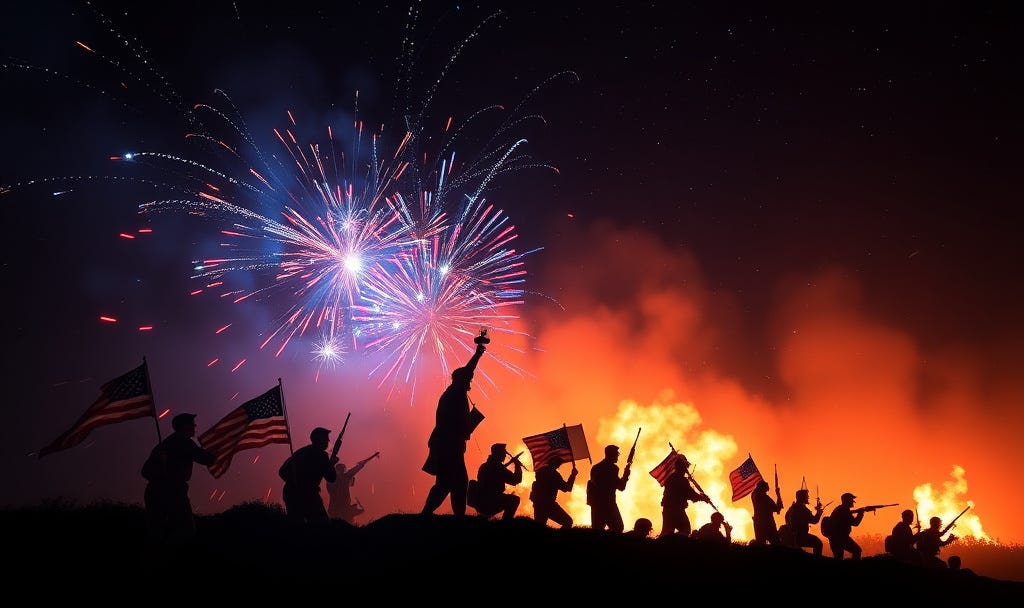
Military technology is not necessarily a scientific challenge or a tactical challenge as much as it is a challenge of engineering and experience. Military capability is a function of many factors, partly the size of one’s military, experience in both senior and junior ranks, and inherited learning both from continuous conflict (where possible) and also from the openness and “nurturing” warrior spirit needed to pass down meaningful learnings so new operators can avoid the mistakes of the past - and potentially even getting killed in the process.
To this end, the raid to arrest Maduro that was executed by Delta Force at the orders of the Trump Administration shows both a level of technical savvy and aggressive ability to execute that far exceeds the level of peer adversaries in Russia, China, Iran and - obviously - Venezuela. Such that “the strong do what they please and the weak suffer what they must” is an old maxim made new again in this “multipolar” world, but the themes emphasized in this blog (namely the “Strategic Competition as a Feature of Civilizational Decline”, “The New Unipolar Moment” and “The United States and China: Has The Torch Already Been Passed?”) much has been explored as to the nature of the current strategic impasse between China and the United States.
In history, where fading empires met rising ones, significant conflict was avoided primarily through integration. This could be considered the case of Greece into Rome or The British Empire into that of the United States. Between the United States, China and its entourage, there is limited capacity for strategic institutional integration because of 1) fundamental cultural differences 2) inherent contradictions between the style and function of the US Federal Bureaucracy and the CCP and 3) popular unwillingness to integrate - has even a single polling bureau thought it necessary to ask whether their is a desire for the US and China to become more tightly merged within themselves?
Additionally, as was explored in the Federalist Paper 10, the constitution of one or another state as they merge can form an oppressive faction which undermines the idea of a state as a unifying body. With this the case, there is limited possibility of strategic integration between China and the United States - except where one is a client of the other - and for that reason conflict will inevitably be the only alternative.
The Current State of the Strategic Conflict
As time proceeds and conflict intensifies, obviously the first order of business is maintaining air superiority in any hot strategic conflict, something for which effective air defense is one of the most meaningful countermeasures. With Venezuela, whether due to bribery, power outage, or actual technical failure, the first domino has already fallen.
Yes air superiority is also signified by a majority of force in the air, in addition to the ability to deny ground-based countermeasures through electronic warfare, along with the ability to sustain such capacity for the duration of a conflict, but on all those measures, it’s unlikely that China or Russia can actually exceed the capacity of the United States, which is now seeing a new investment cycle with the F47 and increased missile defense spending.
There are other means by which this can be undermined - total depletion of military infantry and ground warfare to protect strategic air chokepoints, broader political instability or economic collapse, but this is arguably as likely in China or Russia as it is in the United States. It’s already taking place in Venezuela. While Iran has stated it’s desire to substitute the loss of Venezuela’s meager oil output within BRICS, relations with Venezuela have been a critical economic lifeline for the current Iranian regime.
In recent days, this may have been so impactful as to help precipitate the observed collapse in Iran’s currency and the popular protests, repression of which has now turned violent, while the sequestering of these two client states seems to be more and more definite with their patrons in Russia and China unable to stop the collapsing “house of cards”. Iran already saw a failure at the hands of western air superiority in the “12 Day War” of June 2025, it is unlikely to be able to stop further airstrikes that could further destabilize or decapitate the Iranian regime if Trump seeks to pursue such a path.
The Real Grand Strategy at Play
In the wake of the Maduro Abduction, Trump welcomed oil executives to the White House, who demonstrated a sincere lack of interest in taking on the economic and political risks associated with rebuilding Venezuela’s oil production, particularly as prices trend ever lower.
It would appear in these circumstances that industry interests are actually not aligned with the Trump policy, so what could the angle be? It is well understood historically that much of what drove the Soviet Union into bankruptcy and collapse was low oil prices. While some of this is supposed to have occurred due to coordination between the Reagan Administration and Saudi Arabia in the 1980s, the desire for competitors to outbid other sellers in the price war state that occurred in the 1980s global economy may have been the real driver, but only a driver inasmuch as the Soviet Union simply paid the price for its own mismanagement. With a modernized economy that has much the same export composition, Russia faces the same risks as the Soviet Union did, only 45-odd years on.
Thus, we must consider the strategic objectives at play today. In driving oil prices to unnatural lows, the Trump administration achieves a multitude of strategic goals which may not be obvious on the surface: 1) maintain lower prices for American consumers and the supply chains that serve them amidst a rampant Affordability Crisis, 2) undermine Russia’s ability to compete with other sources of energy on global markets (given that their fixed costs are higher than many Middle Eastern suppliers), 3) drive Chinese buyers into the arms of Saudi and the UAE, which make up the majority of China’s oil imports (ultimately recycling their accumulated capital into US markets given that the United States is their security guarantor, which Trump so cautiously guarded with his first international trip of his new adminstration) and 4) with the active destabilization of Iran and Venezuela, isolate China internationally, exacerbate its divisions with Russia, and force a dual end to both the Ukraine War and a conflict in Taiwan.
We already see economic pressure beginning to mount on the single lifeline Russia has had for external capital - exports to China and India - now that the US is both chasing down tankers and Russia is seeing a backlog on deliveries. While preventing the strategic loss of Taiwan and its chip capacity is ultimately the most uncertain aspect of this grand strategy, an isolated China is less able to act credibly on the international stage, and without conflicts in the Middle East and Europe beggaring attention, at the very least rebuffs what has been a crisis multiple decades in the making and allowing the US to continue maintaining its global security supremacy for at least another generation.
This very last point - US hegemony - is only possible because of other factors which show that the United States may have greater wherewithal to survive a strategic conflict than China, Russia or any other foe, primarily because of demographics, economic and capital multipliers, and the continued quality and loyalty of its military to the constitutional state. This is something that will be explored in a future article.