

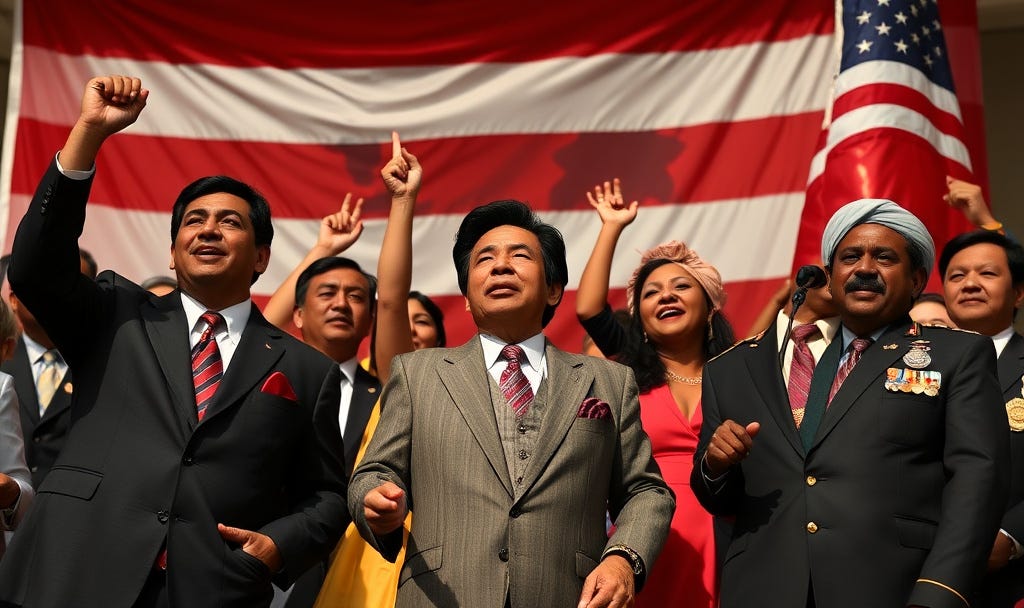
Fixed capital and Human Capital must coexist to survive - namely, if a nation develops sufficient fixed capital, it will inevitably begin to import labor in conditions where human capital does not sustain the standard of living or expectations set forth by the population as a whole.
In the United States as a whole, the trend against mass immigration - rapid ICE protests notwithstanding - is 60 or 70 years in the making, at least since the Hart-Cellar Act. The narrative of the United States being a “Nation of Immigrants” originated in part from John F. Kennedy writing on behalf of the Anti-Defamation League, but the phrase has stuck on liberal lips and conservative craws as a means to define the United States as a country formed by the assent to the conceits of the Declaration of Independence (“all men are created equal, endowed by their creator with… well, well, you know the thing”).
While the pendulum swings back and forth, the history of United States and western societies more generally as “open” and “free” is based firstly on honor-bound clan balances of power and secondly on the ability to import and integrate higher-value-added sources of labor. This is true all the way back to antiquity, where the aggregation of new stakeholders - whether it be in Athens or Rome - led to a more advanced political economy than neighboring states, and ultimately drove a virtuous cycle that enabled greater political autonomy, the defeat and subordination of a variety of enemies, and the subsequent incorporation of those enemies into a broader, more specialization-driven economic and trade system.
The downside of this cycle is the decline of the standard of living for a great many of the people who constitute the early “core” of an imperial structure, while eventually those on the “periphery” (to borrow framing from Immanuel Wallerstein) see it as more advantageous to participate in the core’s economic system and gain higher marginal benefits as a result.
This could potentially explain why it is actually many newcomer populations to the United States, mostly Latinos, who constitute the largest incremental vote gains for the “anti-immigration” side of the aisle - the Republicans. These voters, although not a majority of their own demographic, are fighting harder to maintain the marginal utility of a system which they are new to and which they still find benefits them sufficiently to fight in order to keep others out. It is no small coincidence that nearly 30% of ICE agents and 50% of Border Patrol agents in the United States are Latino. The reasons for this may vary, but even if it is simply because they want to hold down a job, the benefits of empire are sufficient for them to “turn their back on their kin” (a blood and soil liberal framing if we could ever conceive of one).
The impacts of increasingly nationalistic Latino populations on US politics will probably make the nation unfamiliar in other ways, but it also infuses the United States with new vitality and new energy. US Latinos are not short of astronauts, scientists, capable manufacturing engineers or committed soldiers - all the constituent stakeholders which allow for a strong national state to persist through instability. Furthermore, the willingness of US Latinos to integrate within “American” culture - while putting their own imprint on it - is effectively the only tool the economic system needs to continue driving a value-added expansion.
Despite China outstripping the United States in Capital Formation, its population will likely halve in the next 60 to 80 years, while the United States will continue to grow at a steady pace. This does not mean that China will ultimately lose a conflict with the United States, but it makes one unattractive, and if the population decline is sufficient, it will likely undermine the overall stability of the CCP and drive then Chinese populations into the arms of greater economic integration with the United States - where they will inevitably adopt a more servile position than they experience in their own institutions.
In fuller irony, the Maduro raid also raises the interest and loyalty of many US Latinos who have historically rejected or migrated away from Liberation Theology-tinged leftism which has predominated in Central and South America. This particular ethnic group will continue to drive more and more of the discourse in American politics, much the same way that North Africans, Near Easterners, Huns and Gauls began to predominate in the high period of the Roman Empire.
The real “theological” risk to the United States is that identity fails to reorient into a new basis of integration… “the center does not hold”, and ultimately individuals and groups will find it more attractive to fall back on tribal divisions than to devote their loyalty to a central state. Such are the wages of empire, but an empire that is predicated on growth will never survive without fresh blood: much as the Romans may have looked at the Rape of the Sabines as a necessary evil (if they discussed it at all), they also rationalized it by emphasizing that Sabine wives were treated humanely. Ultimately, this is a microcosm of what allowed that Empire to grow: the growth inherently involved dilution, but with that dilution also came vigor and energy.
It is eventually, perhaps, when all the new vigor of foreign lands does not hold that the center does in fact fall to pieces.